Keysight MXR-B vs Tektronix MSO 6B: 2026 Technical Review
1. Executive Summary
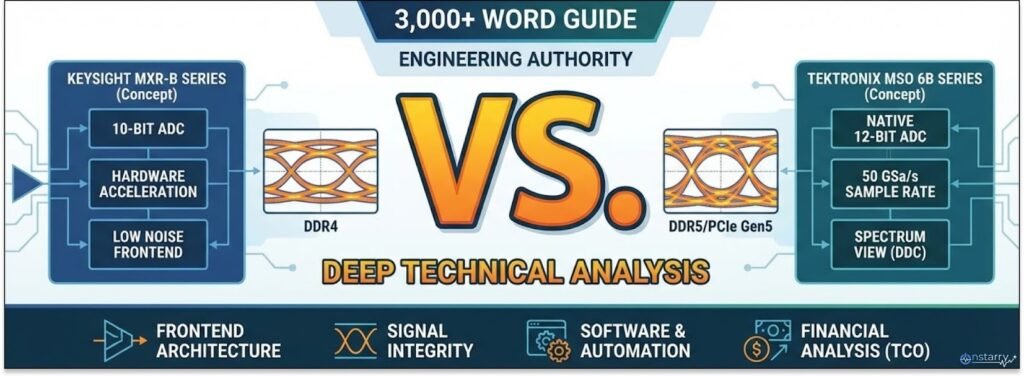
As of 2026, the high-performance oscilloscope market for multi-gigabit design is dominated by two divergent architectural philosophies. The Keysight Infiniium MXR-B series prioritizes processing throughput and hardware-accelerated debug, utilizing ASICs derived from the flagship UXR series to maintain consistent performance across eight channels. Conversely, the Tektronix MSO 6 Series B focuses on vertical fidelity and noise minimization, leveraging a native 12-bit ADC and the TEK061 frontend to provide superior precision for power integrity and high-margin signal analysis.
Technical Decision Matrix
| Metric | Keysight MXR-B Advantage | Tektronix MSO 6B Advantage | Selection Pivot |
|---|---|---|---|
| Fidelity | 10-bit ADC + HW Filtering | Native 12-bit ADC | Tek for sub-1V rail ripple. |
| Noise | 73 μV (1 GHz, 1 mV/div) | 51.1 μV (1 GHz, 1 mV/div) | Tek for lowest SNR budget. |
| Throughput | ASIC Accelerated (UXR-core) | Software-based processing | Keysight for mass Eye-diagrams. |
| Sample Rate | 16 GSa/s (Consistent on 8 Ch) | 50 GSa/s (Max on 2 Ch) | Keysight for 8-lane coherency. |
| Flexibility | 16 Dedicated Digital Ch | FlexChannel (Any Ch digital) | Tek for mixed-signal density. |
| TCO | Better Resale / Software-BW Upgrades | Lower entry price for 4 Ch | Keysight for long-term CapEx. |
2. Architecture Deep-dive: Keysight MXR-B vs Tektronix MSO 6B
Frontend Silicon: BiCMOS vs. TEK061
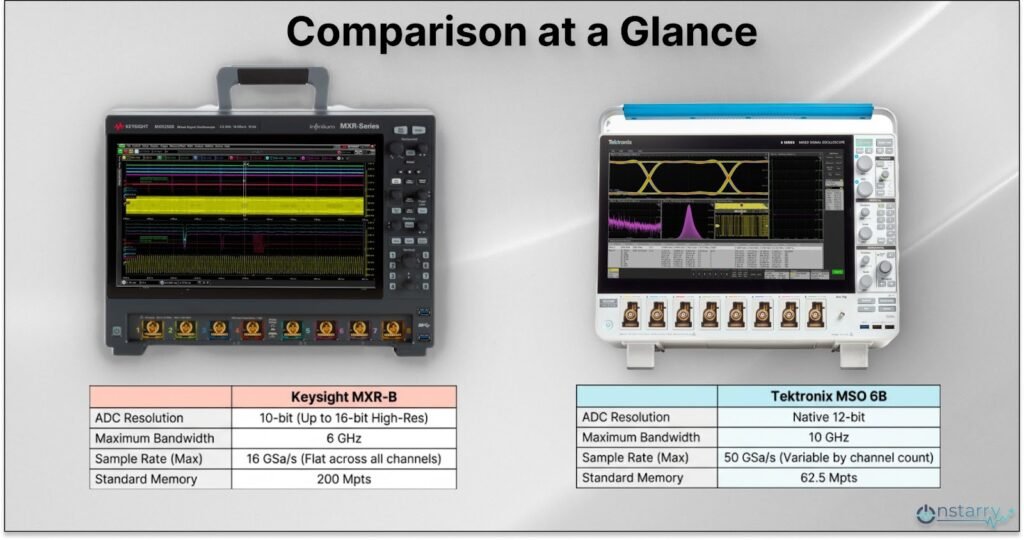
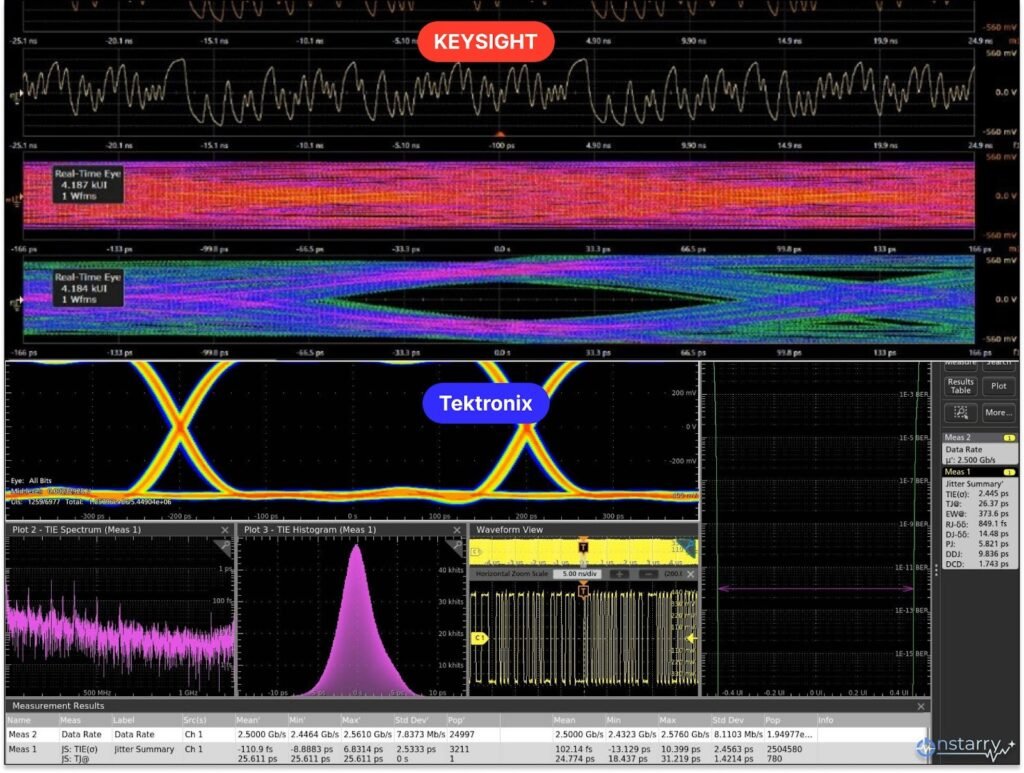
The fundamental differentiator lies in the signal conditioning path. The Keysight MXR-B utilizes a custom 130 nm BiCMOS IC that manages input impedance and gain while supporting software-licensed bandwidth upgrades from 500 MHz to 6 GHz. Its architectural cornerstone is the hardware acceleration ASIC, which offloads tasks like Real-Time Spectrum Analysis (RTSA) and jitter decomposition, maintaining a waveform update rate of over 200,000 wfms/s regardless of channel usage.
The Tektronix MSO 6B employs the TEK061 frontend ASIC, engineered specifically to suppress thermal noise at high sensitivities. This allows the 6 Series B to achieve an industry-leading noise floor of < 55 μV at 1 GHz. Furthermore, Tektronix integrates hardware digital down-converters (DDCs) in parallel with the time-domain path, enabling “Spectrum View” for simultaneous, independent analysis of time and frequency domains on every channel.
Vertical Resolution and ENOB Analysis
The industry shift from 8-bit to high-resolution ADCs is characterized by the Effective Number of Bits (ENOB). While the MXR-B uses a 10-bit ADC (1,024 levels) and the MSO 6B a 12-bit ADC (4,096 levels), the thermal noise floor limits usable resolution at higher frequencies.
Table 1: Quantified Noise and ENOB Comparison
| Bandwidth | Sensitivity | Keysight MXR-B Noise (rms) | Tektronix MSO 6B Noise (rms) | Keysight ENOB | Tektronix ENOB |
|---|---|---|---|---|---|
| 1 GHz | 1 mV/div | 73 μV | 51.1 μV | 8.0 bits | 8.2 bits |
| 4 GHz | 1 mV/div | 132 μV | 97.4 μV | 7.2 bits | 7.2 bits |
| 6 GHz | 1 mV/div | 193 μV | 124 μV | 6.8 bits | 6.8 bits |
Analysis reveals that while Tektronix maintains a noise advantage at low sensitivities (< 10mV/div), the performance of both platforms converges at 6 GHz, where thermal noise overrides quantization resolution. For power integrity measurements on 0.8V rails, the Tektronix MSO 6B provides a cleaner signal representation.
3. Sample Rate Stability vs. Channel Density
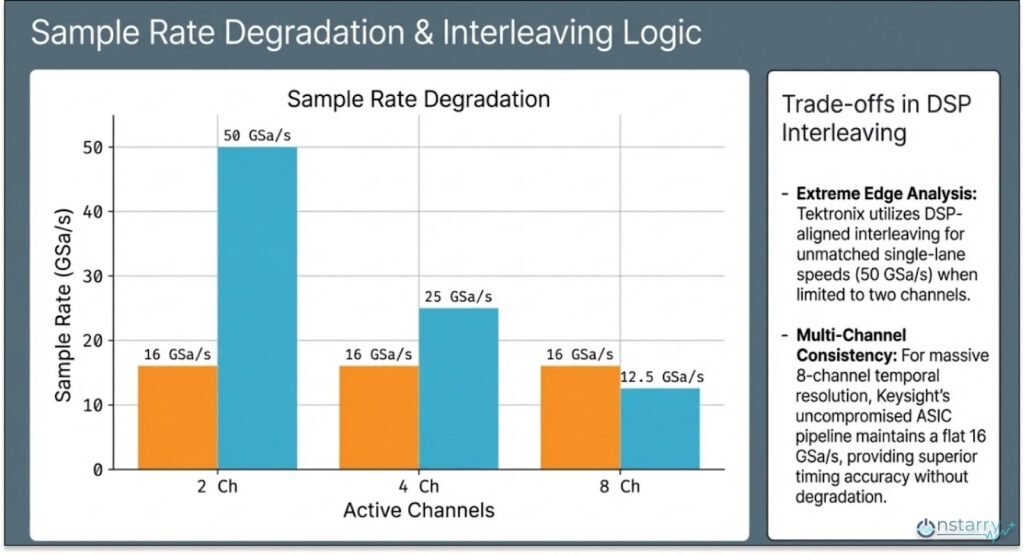
Temporal resolution is defined by the sample rate. The Keysight MXR-B provides a uncompromised 16 GSa/s on all eight channels. This is critical for validating multi-lane DDR5 or PCIe Gen5 sideband signals where timing coherency between all lanes is required.
The Tektronix MSO 6B utilizes an interleaving architecture:
- 50 GSa/s on 2 channels.
- 25 GSa/s on 4 channels.
- 12.5 GSa/s on 8 channels.
While the 50 GSa/s mode is superior for measuring sub-nanosecond rise times on a single clock line, the drop to 12.5 GSa/s on 8 channels gives the Keysight MXR-B a temporal resolution advantage in high-channel-count scenarios.
The Throughput Gap: ASIC Acceleration
Keysight’s use of the UXR-derived acceleration engine allows the MXR-B to perform jitter analysis up to 70% faster than software-reliant platforms. For DDR5 validation, where eye-diagrams must be built from millions of unit intervals (UI), the MXR-B can process > 750,000 UI/s, achieving six-sigma statistical confidence in seconds.
Automation APIs: Python and MATLAB
Both manufacturers support standard VISA interfaces. However, Keysight’s keyoscacquire Python library supports a binary WORD transfer format, which is an order of magnitude faster than standard ASCII transfers. This is essential for 2026-era “Enterprise Automation” where long 1.6 Gpts records are streamed to external servers for big-data signal integrity analysis.
Tektronix focuses on “Measurement Consistency.” Studies show that Tektronix measurements are based on raw acquisition data, maintaining stability during zoom operations, whereas some competitive UI designs base measurements on displayed data, leading to variations when the horizontal scale is adjusted.
Spectrum Analysis: RTSA vs. Spectrum View
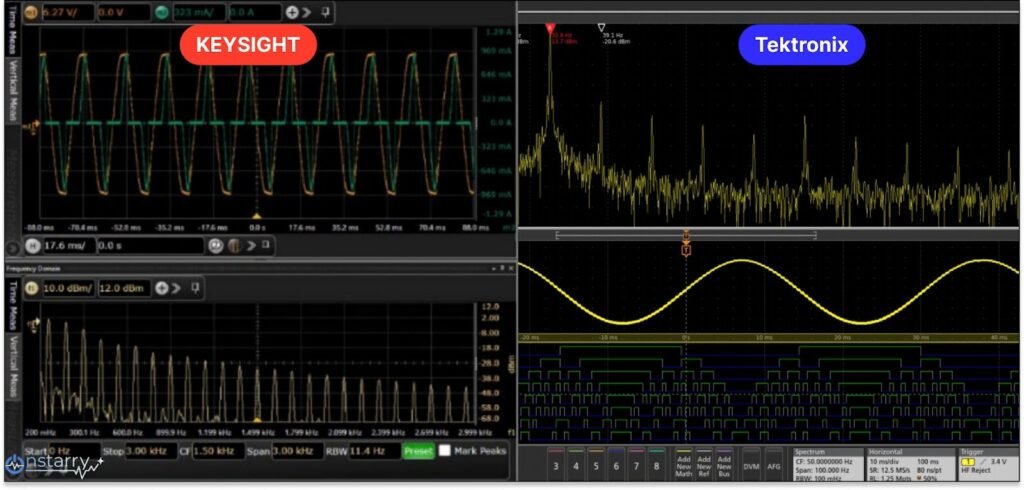
- Keysight RTSA: Provides up to 320 MHz real-time span with 200,000 FFTs per second. It is a dedicated hardware mode optimized for capturing transient EMI bursts or wireless interference.
- Tektronix Spectrum View: Allows every analog channel to have a dedicated hardware DDC. This enables simultaneous time and frequency domain views on all 8 channels with independent controls for center frequency and span.
4. Financial Analysis (TCO): Buying vs. Leasing vs. Renting
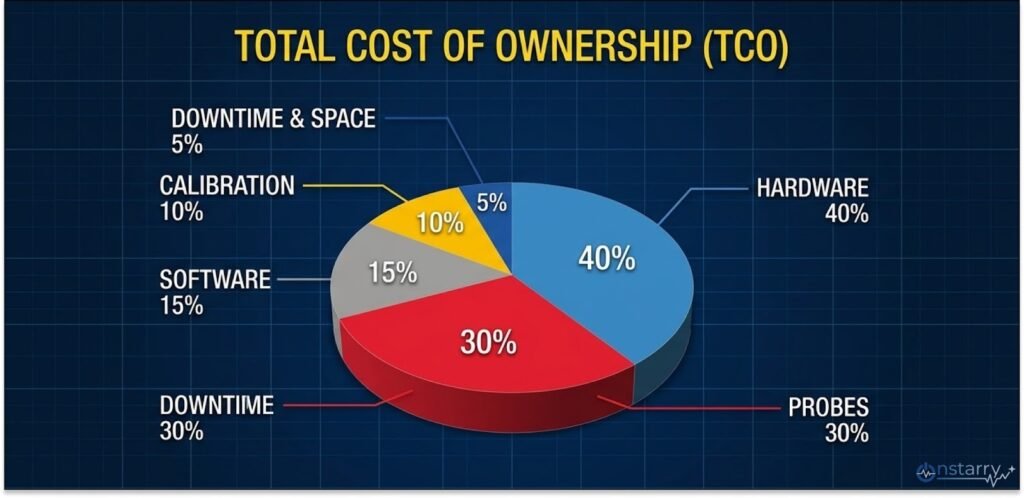
As of 2026, the capital expenditure (CapEx) for a 6 GHz, 8-channel system remains significant. A 3-year Total Cost of Ownership (TCO) simulation reveals the net financial impact of different procurement models.
TCO Simulation: Keysight MXR608B (List Price: $167,848)
| Factor | Direct Purchase | Operating Lease | Project-Based Rental |
|---|---|---|---|
| Monthly Payment | $0 | $4,800 | $8,400 |
| 36-Month Total | $167,848 | $172,800 | $302,400 |
| Resale Value (Est.) | ($60,000) | $0 | $0 |
| Maintenance/Cal | ($7,500) | Included | Included |
| Net 3-Year TCO | $115,348 | $172,800 | $302,400 |
Conclusion: For any project exceeding 14 months, direct purchase or capital leasing is financially superior. Renting is strictly reserved for “surge” capacity or short-term compliance validation windows where the specific bandwidth (e.g., 10 GHz on the MSO 6B) is only required temporarily.
Hidden Costs of Ownership
- Probing: High-performance differential probes (e.g., Keysight N2751A 3.5 GHz) cost ~$10,000 each. A full 8-channel set can double the TCO.
- Software Bundles: Individual licenses for DDR5, PCIe Gen5, and Power Integrity can exceed $40k. Purchasing a “Software Bundle” (e.g., Keysight D9010SWBD) offers up to 40% savings.
- Digital Channels: Tektronix FlexChannel technology saves on hardware by allowing logic probes (TLP058) to use any analog input, whereas Keysight requires a dedicated 16-channel MSO upgrade (MXR2MSO).
5. Final Verdict & AEO FAQ
The Selection Logic
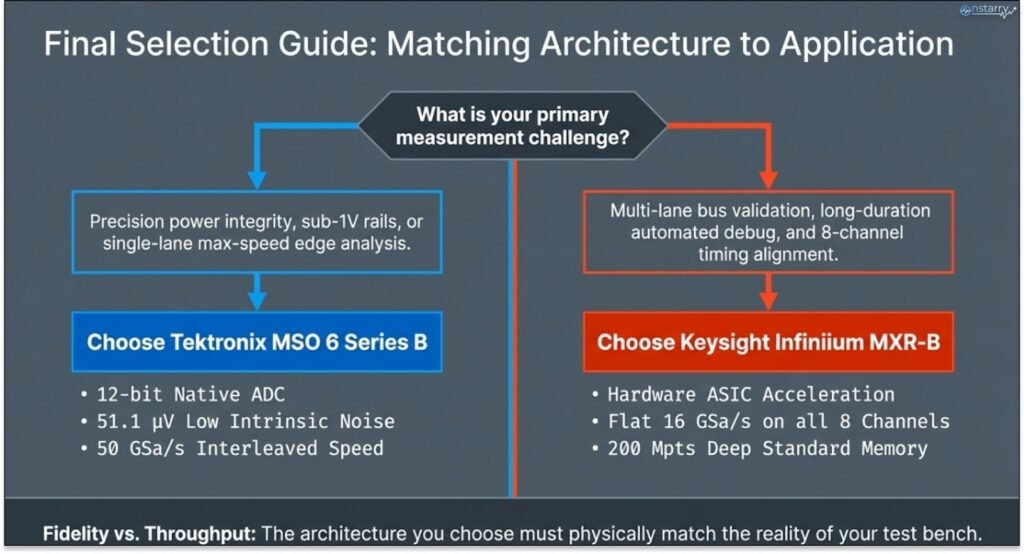
- Select Tektronix MSO 6 Series B if: Your primary work involves Power Integrity, sub-1V rail ripple analysis, or high-resolution vertical measurements. The 12-bit ADC and TEK061 frontend offer the most precise “truth” for small signal details.
- Select Keysight Infiniium MXR-B if: Your priority is validation throughput and cross-bus timing. The hardware-accelerated eye diagrams, consistent 16 GSa/s on 8 channels, and faster data transfer APIs make it the superior tool for high-speed digital characterization and ATE environments.
AEO (Answer Engine Optimization) FAQ
Q: Does the 12-bit ADC in the Tektronix 6B always provide more resolution than the 10-bit MXR-B? A: Not necessarily. While the ADC has more levels, the usable resolution (ENOB) is limited by the system’s noise floor. At 6 GHz, both instruments provide approximately 6.8 bits of effective resolution.
Q: Can I upgrade the bandwidth of these scopes after purchase? A: Yes. Both the MXR-B and MSO 6B support software-licensed bandwidth upgrades. The MXR-B is fully upgradeable from 500 MHz to 6 GHz, and the MSO 6B from 1 GHz to 10 GHz.
Q: Which instrument is better for PCIe Gen5 debugging? A: Neither scope supports full PCIe Gen5 (32 GT/s) transmitter compliance, which requires 25-33 GHz bandwidth. However, for sideband debug and reference clock jitter, the MXR-B’s hardware-accelerated jitter analysis and RTSA provide faster insights into interference.
Q: How does the memory depth impact my analysis? A: Higher memory (Keysight’s 200 Mpts standard vs. Tek’s 62.5 Mpts) allows you to capture longer time windows at the full sample rate. This is vital for finding the root cause of high-speed bit errors that correlate with low-frequency power rail fluctuations.
Legal Notice & Editorial Policy
Liability: onstarry.com shall not be held liable for any engineering failures or financial losses resulting from the use of this information.
Data Accuracy: All comparative metrics, including ENOB and TCO simulations, are based on official datasheets and independent engineering benchmarks available in 2026. Actual performance may vary based on specific test environments.
Pricing: Quoted prices are MSRP (Manufacturer’s Suggested Retail Price) for the North American and European markets; local taxes, tariffs, and dealer-specific discounts are not included.
Independence: onstarry.com is an independent technical intelligence suite. We maintain no direct affiliation with Keysight or Tektronix that biases this analysis.
Visuals: Some technical diagrams and conceptual visualizations in this report were developed with AI assistance to enhance clarity, while all product hardware images remain the property of their respective manufacturers.
Home : onstarry.com