Finding the **best PCB assembly services for prototypes in 2026** is the most critical decision for any hardware engineer; I’ve spent two decades at the lab bench in Silicon Valley to prove it., and if there’s one thing I’ve learned, it’s that a bad prototype partner is the silent killer of hardware startups. By early 2026, the game has changed. We aren’t just checking if an LED blinks anymore; we’re managing 6G signal integrity and massive thermal loads for AI servers that require 50 to 60 times the PCB density of legacy hardware.
Finding the best PCB assembly services for prototypes in 2026 isn’t just about who is the cheapest—it’s about who has the technical ceiling to handle 01005 passives and Ultra-HDI designs without blinking.
Comparing the Best PCB Assembly Services for Prototypes in 2026
Before we dive into the boots-on-the-ground details, here is how the top players stack up this year:
| Feature | JLCPCB | PCBWay | MacroFab | Sierra Circuits | Proto-Electronics |
| Primary Region | Asia / Global | Asia / Global | North America | North America | Europe |
| Max Layers | 32 Layers | 60 Layers | 36 Layers | 30 Layers | 18 Layers |
| Min Component | 0201 | 0201 | 01005 | 01005 | 01005 |
| 2L Lead Time | 24 – 48 Hours | 3 – 5 Days | 3 – 10 Days | 24 – 48 Hours | 5 Working Days |
| AI-DFM Tool | JLCDFM | PCBWay DFM | FabIQ Engine | Better DFM | Proto-DFM |
1. Sierra Circuits: The “No-Fail” Specialist
If you’re working on aerospace, medical, or defense projects where failure isn’t an option, Sierra is the gold standard.
- The Edge: They can pull off a 30-layer board in 24-48 hours. That is unheard of for most shops.
- Precision: They support 1.5 mil trace and space—essential for those tiny wearable sensors we’re seeing everywhere in 2026.
- TheTrade-off: You’re going to pay for it. They have the highest cost-per-unit in the market, but you’re paying for MIL-spec and ISO 13485 peace of mind.
- Veteran Tip: Use them when the deadline is tighter than your trace clearances. [Check Sierra’s Live Lead Times Here].
- This makes them one of the best PCB assembly services for prototypes in 2026 for high-reliability sectors.
2. JLCPCB: The IoT Powerhouse
For cost-sensitive IoT prototyping, JLCPCB is still the king of automated speed.
- The Edge: Their “Free POFV” (Plated Over Filled Via) for 6+ layer boards is a lifesaver for compact designs, helping you dodge those nasty cost penalties.
- Speed: They maintain a 24-48 hour lead time on standard 2-layer builds.
- The Trade-off: When you push the design rules on larger batches, the community has seen defect rates up to 10%.
- Veteran Tip: Great for rev 1 and rev 2. Just run their JLCDFM tool early to catch errors. [Calculate Your JLCPCB Quote].
- If your project requires HDI, they are among the best PCB assembly services for prototypes in 2026.
3. PCBWay: The HDI & Flex Heavyweight
When your design gets weird—think rigid-flex or 60-layer behemoths—PCBWay has the broadest technical envelope in Asia.
- The Edge: Their HDI support (up to 6+N+6) is what you need for high-pin-count FPGAs and complex BGA escapes.
- Precision: They use high-precision laser drilling (3-4 mil) to ensure those dense prototypes actually work.
- The Trade-off: Complexity takes time. Expect a 1-2 day manual review and lead times that can stretch to 20 days for the “crazy” builds.
- Veteran Tip: They are the best choice for complex HDI. [Explore PCBWay’s Technical Specs].
4. MacroFab: North American Scaling
MacroFab is the “cloud-native” choice, acting as an orchestrator for over 40 factories across North America.
- The Edge: Their FabIQ Engine uses AI for real-time sourcing and automated DFM flags. It’s built for “factory portability,” making it easy to scale from one prototype to a mid-sized run.
- Precision: They are fully optimized for 01005 package assembly.
- The Trade-off: Pricing has outpaced Asian competitors, so it’s likely out of reach for hobbyists.
- Veteran Tip: Use MacroFab if you need digital transparency and a path to domestic scaling. [Try the FabIQ Engine].
5. Proto-Electronics: Europe’s Fast Track
If you’re operating in Europe and want to avoid intercontinental tariffs, this is your best bet.
- The Edge: They offer 10-minute online quotes and have arguably the best UI in Europe for navigating regional regulations.
- The Trade-off: They max out at 18 layers. If you’re building a server-grade AI board, you might hit their ceiling early.
Key Takeaways for 2026
To summarize the best PCB assembly services for prototypes in 2026, consider your specific project needs first.
- Speed & Reliability (US): Sierra Circuits.
- Low-Cost IoT: JLCPCB.
- Complex HDI/Flex: PCBWay.
- Digital Transparency (US): MacroFab.
Engineering Checklist Before You Upload
The following steps ensure you get the most out of the best PCB assembly services for prototypes in 2026.
- Run AI-DFM Early: Tools like Better DFM or FabIQ identify signal crosstalk before you waste money on a bad spin.
- Verify 01005 Support: Don’t let a provider stick you in a high-cost “advanced” tier just for small passives.
- Check for EOL Parts: Use AI agents to find alternatives for out-of-stock components before they stall your build.
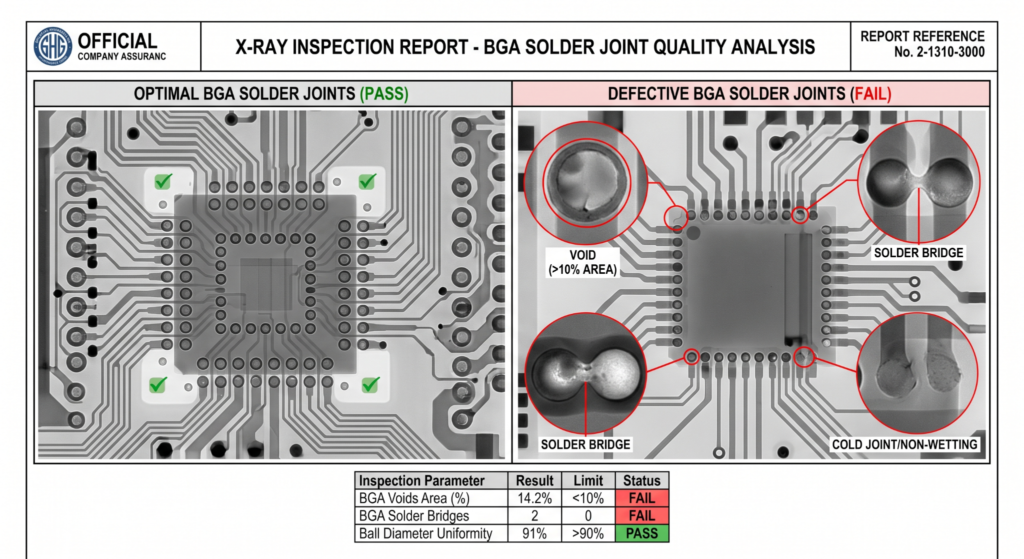
- X-Ray is Non-Negotiable: For BGA or LGA components, you need X-ray verification to find hidden bridges or voids.
FAQ: Best PCB Assembly Services for Prototypes in 2026
Q: Who is the fastest PCB assembly service in 2026? A: For ultra-rapid complex boards, Sierra Circuits offers 24-48 hour turnarounds. For standard 2-layer builds, JLCPCB maintains a similar 24-48 hour window.
Q: What is the biggest cost driver in 2026? A: Components now make up 50% of the total cost, followed by SMT assembly at 25%.
Q: Why is X-ray inspection important for 2026 prototypes? A: With 0.35mm pitch BGAs becoming standard, electrical failures often happen under the device body where they can’t be seen.
For locating sub-millimeter short circuits and thermal bottlenecks during the initial board bring-up phase, check out our in-depth guide on [Thermal Imaging for PCB Debugging and Power Integrity].
In this industry, we say “hardware is hard,” but in 2026, it’s more about “hardware is integrated.” If you aren’t using these AI-DFM tools early, you’re basically burning money on high material costs.
What’s the most expensive mistake you’ve caught during a DFM review, or did it make it all the way to the lab bench before it went “pop”?
Which of these services are you planning to use for your next high-speed design?
Home : onstarry.com