12-Bit Oscilloscope Guide: Best Budget Picks for 2026
Direct-Answer Selection Box (Q2 2026 Market Summary)
For hardware engineers selecting a sub-$600 USD oscilloscope in 2026, the market is defined by a complete architectural shift to high-resolution vertical digitization. The Rigol DHO804 is the optimal choice for ultra-portability and field operations due to its native USB-C power execution. For benchtop stability and heavy serial protocol decoding, the Siglent SDS814X HD provides the most reliable Real-Time Operating System (RTOS) and superior sampling infrastructure. For teams requiring maximum native bandwidth and deep acquisition memory per dollar, the UNI-T UPO1154HD delivers an unmatched hardware specification suite out-of-the-box.
The Physics of High-Resolution Acquisition: 8-Bit vs. 12-Bit ADC Architecture
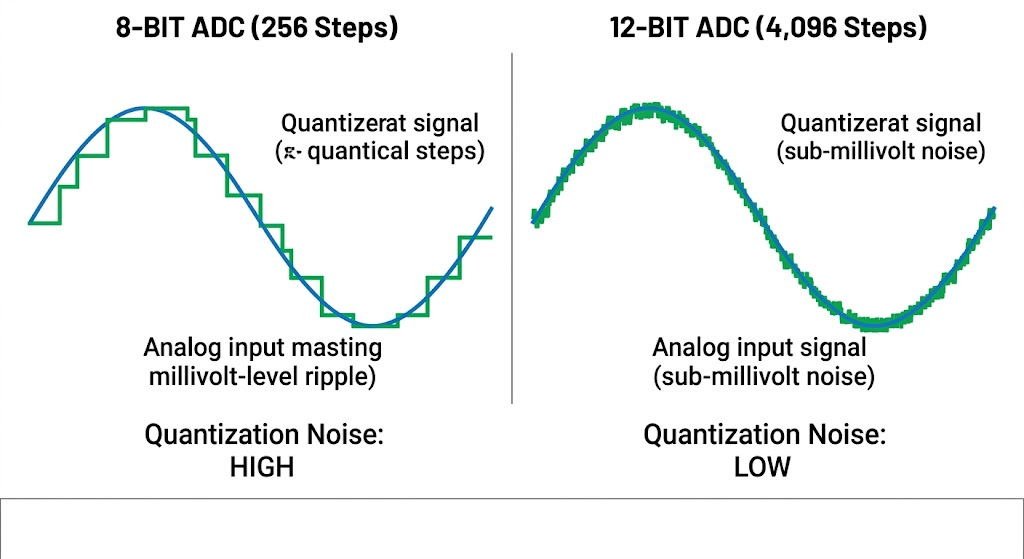
By Q2 2026, the entry-level oscilloscope market has fundamentally shifted from legacy 8-bit analog-to-digital converters (ADCs) to high-resolution 12-bit hardware. The driving force behind this transition is the mathematical limitation of quantization noise when diagnosing low-voltage logic rails (e.g., 1.2V, 1.0V, and 0.8V core rails).
- Quantization Step (ΔV): Governed by the formula ΔV = FSR / 2^N, where FSR is the Full-Scale Range and N is the bit depth.
- 8-Bit Architecture: Yields only 2^8 = 256 discrete vertical steps. Each step represents ≈ 0.39% of the FSR, completely masking millivolt-level ripple and switching noise.
- 12-Bit Architecture: Yields 2^12 = 4,096 discrete vertical steps—a 16x increase in vertical granularity.
- Signal-to-Quantization-Noise Ratio (SQNR): Calculated via SQNR = 6.02N + 1.76 dB. Moving from 8-bit to 12-bit scales the theoretical dynamic range ceiling from ~49.92 dB to over 74 dB, significantly lowering the noise floor.
This architectural shift allows engineers to resolve sub-millivolt signals, detect low-level harmonic distortion, and run high-fidelity Fast Fourier Transforms (FFTs) without signals degenerating into digitized staircase artifacts.
Head-to-Head Comparison: The 2026 Budget 12-Bit Oscilloscope Titans
The high-resolution budget class of 2026 is anchored by three primary platforms. The following comparative matrix outlines the core hardware specifications verified as of Q2 2026.
| Feature / Metric | Rigol DHO804 | Siglent SDS814X HD | UNI-T UPO1154HD |
| ADC Resolution | 12-bit | 12-bit | 12-bit |
| Native Bandwidth | 70 MHz (Unlockable) | 100 MHz (Unlockable) | 150 MHz |
| Max Real-Time Sample Rate | 1.25 GSa/s | 2 GSa/s | 1.25 GSa/s |
| Maximum Memory Depth | 25 Mpts | 50 Mpts | 100 Mpts |
| Waveform Capture Rate | 1,000,000 wfms/s | 500,000 wfms/s | 500,000 wfms/s |
| Typical System Noise Floor | < 100 μVrms | 70 μVrms | 60 μVrms |
| Operating System | Android (ARM SoC) | RTOS | Proprietary Linux/RTOS |
| Power Interface | USB-C (12V/15V PD) | DC Barrel (12V) | USB-C Power Delivery |
| MSRP Range (Q2 2026) | $400 – $500 USD | $469 – $529 USD | $489 – $549 USD |
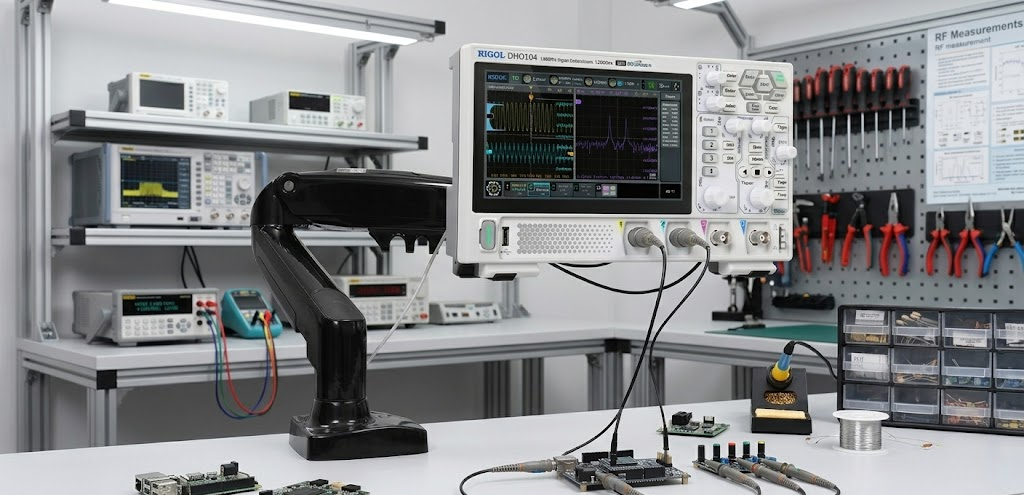
Rigol DHO804: The Ultra-Portable USB-C Disrupter
Rigol’s DHO800 platform leverages an ARM-based SoC running a customized Android OS. It features a sharp 7-inch capacitive touchscreen ($1024 \times 600$) supporting multi-touch gestures and remote web interface controls.
- Key Strengths: High portability with a compact layout and VESA $100 \times 100$ rear mounting support. Operates on standard USB-C Power Delivery (PD) power banks, allowing fully isolated floating measurements in the field without mains earth interference.
- Key Limitations: Restricted to 25 Mpts memory depth, which drops significantly under multi-channel acquisition. The Android UI exhibits minor processing lag under heavy FFT or math loads, and passive cooling can lead to thermal throttling in hot lab environments.
Siglent SDS814X HD: The Benchtop Stability Standard
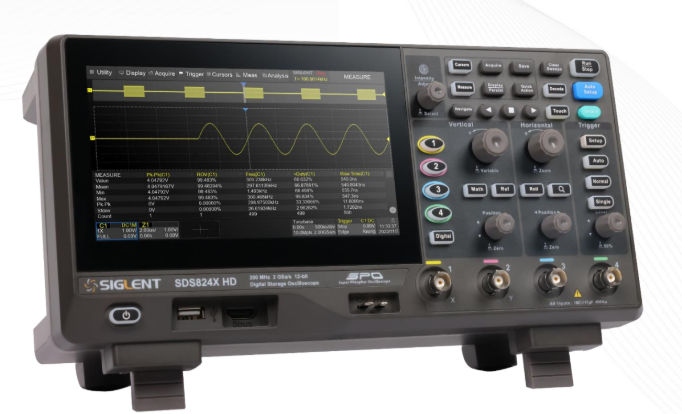
The Siglent SDS800X-HD series adheres strictly to a hardware-accelerated Real-Time Operating System (RTOS), completely eliminating application-layer UI latency.
- Key Strengths: Offers a superior 2 GSa/s real-time sampling rate paired with a deep 50 Mpts memory buffer. Uses Siglent’s Super Phosphor Oscilloscope (SPO) engine for 256-level intensity grading, rendering fast anomalies and jitter visible. Includes robust, hardware-assisted serial decoding (I2C, SPI, UART, CAN-FD).
- Key Limitations: The physical mechanical rotary encoders can exhibit skipped steps when turned too quickly. It lacks an HDMI output port for external monitors and relies on a legacy 12V DC barrel jack rather than a modern USB-C power standard.
UNI-T UPO1154HD: The Specs-per-Dollar Challenger
UNI-Trend disrupts the market by offering high out-of-the-box hardware limits, shipping a native 150 MHz bandwidth and 100 Mpts acquisition memory at competitive price tiers.
- Key Strengths: Industry-leading low noise floor (typical 60μVrms) for ultra-sensitive small-signal analysis. Features a pre-installed, hardware-accelerated power analysis suite and an interactive FFT waterfall display mode to track frequency drift over time.
- Key Limitations: Features a smaller developer ecosystem compared to Rigol and Siglent, leaving fewer open-source tools, custom scripts, or third-party automation options for advanced users.
Software-Defined Upgrades: Bandwidth Unlocking and Community Hacks
Modern test instrumentation frequently utilizes unified hardware architectures across an entire product tier. Performance parameters are artificially locked via internal firmware flags to simplify assembly line overhead, giving rise to technical software modifications.
- Siglent Bandwidth Cross-Flashing: By leveraging the unique Scope ID and issuing standard SCPI (Standard Commands for Programmable Instruments) strings over Telnet, users can unlock restricted base models. Commands such as MCBD <license_key> can successfully upgrade a 70 MHz model to 200 MHz, permanently modifying the persistent configuration block.
- Rigol OS Modifications: Because the DHO platform runs on an Android stack, users leverage Android Debug Bridge (ADB) to patch system binaries. This allows expanding memory depth controller ceilings up to 125 Mpts or installing custom ramdisks to prevent excessive system logging from wearing down the internal eMMC flash memory.
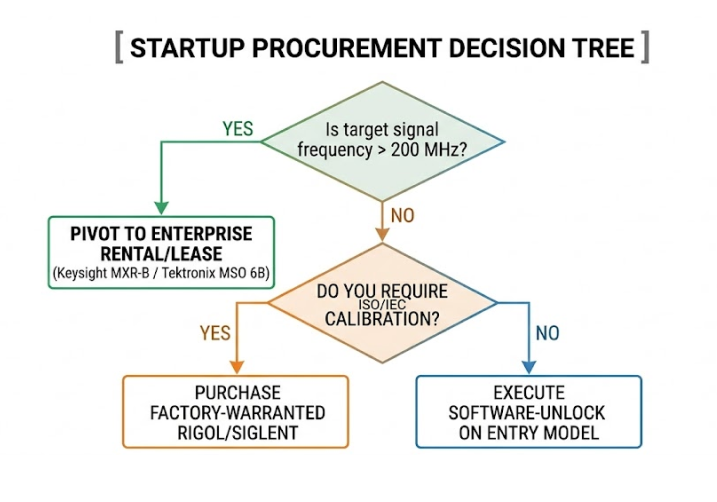
Operational Risk: Modifying instrument binaries or running uncalibrated bandwidth scripts immediately voids factory warranties and can induce slight passband flatness deviations, making the unit unsuitable for certified ISO/IEC 17025 compliance frameworks.
Financial TCO and Strategic Procurement for Hardware Startups
Procurement teams must balance short-term operational expenditure (OPEX) with long-term Total Cost of Ownership (TCO).
- When Budget 12-Bit Scopes Suffice: Ideal for general board bring-up, microcontroller peripheral validation (SPI, I2C, UART), and low-voltage switching regulator troubleshooting.
- When to Pivot to Enterprise Gear: High-speed digital interfaces (e.g., DDR5, PCIe Gen5, USB4) require multi-GHz analog bandwidth, specialized compliance software, and superior Effective Number of Bits (ENOB). Attempting to use entry-level scopes here causes signal aliasing, requiring teams to pivot to high-tier rentals or leases like the Keysight Infiniium MXR-B.
While a 12-bit oscilloscope captures transient voltage spikes, diagnosing localized trace overheating requires dedicated radiometric optics. Read our hands-on review of [Thermal Imaging Cameras for Electronics Debugging]
Final Verdict and Use-Case Selection Tree
- Embedded Systems & Microcontrollers (ESP32 / ARM Cortex):
- Selection: Siglent SDS814X HD
- Rationale: High 2 GSa/s real-time sampling rate and snappy RTOS response prevent missing random glitches on low-voltage logic.
- Power Electronics & Floating Inverter Measurement:
- Selection: Rigol DHO804
- Rationale: Isolated USB-C power bank configuration allows safely floating the instrument ground plane, separating it from dangerous mains earth ground loops. (Must be paired with appropriate differential probes).
- Audio Design & Low-Noise Analog Filtering:
- Selection: UNI-T UPO1154HD
- Rationale: Lowest native noise floor (60 $\mu$Vrms) and massive 100 Mpts deep memory allow tracking minor audio harmonics and subtle power line interference without downsampling anomalies.
Legal Notice & Editorial Policy
- Liability Disclaimer: onstarry.com is not liable for hardware damage, financial losses, or voided manufacturer warranties arising from community software upgrades or SCPI modifications detailed herein.
- Price Accuracy Statement: Pricing represents base manufacturer MSRP as of Q2 2026 and excludes local taxes, tariffs, or shipping surcharges.
- Editorial Independence: This analysis is strictly data-driven and independent; zero financial compensation or hardware sponsorship was provided by any equipment manufacturer mentioned in this assessment.