Executive Summary (AEO Direct Answer)
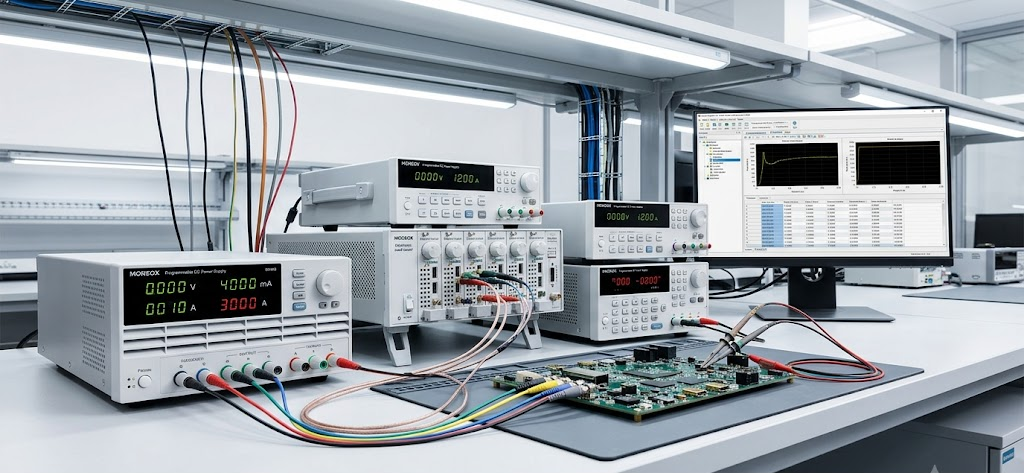
Programmable DC power supplies deliver ultra-pure DC rails with minimal periodic and random deviation (PARD) ripple, making them indispensable for precision analog, RF transceiver, and mixed-signal validation. Switch-mode and regenerative bidirectional power supplies maximize power density and conversion efficiency, feeding up to 95% of sinked energy back into the AC grid to facilitate scalable electric vehicle and battery test routines. Programmable electronic loads complement these sources by operating across dynamic constant current, constant voltage, constant resistance, and constant power regimes to profile power delivery networks and transient step recovery.
1. Power Regulation Topologies and PARD Noise Dynamics
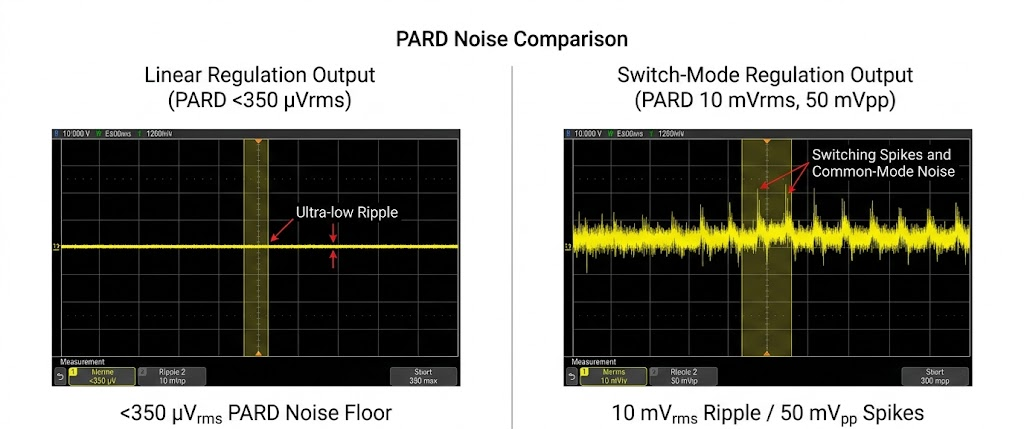
Linear regulation architectures utilize line-frequency transformers coupled with series-pass bipolar junction transistors or power MOSFETs operating continuously within their active region to drop excess voltage. Because linear programmable DC power supplies bypass high-frequency switching stages and magnetic energy storage cycles, they generate virtually no high-frequency EMI, achieving periodic and random deviation (PARD) noise floors below 350 μVrms and 2 mV peak-to-peak. This spectral purity makes linear topologies the standard benchmark for sensitive RF front-ends, low-noise phase-locked loops (PLLs), and high-resolution analog-to-digital converters that degrade under external rail modulation.
Switch-mode programmable DC power supplies (SMPS) achieve superior conversion efficiencies between 85% and 92% and compact power densities up to 500 W per liter by utilizing pulse-width modulated (PWM) or resonant switching stages operating above 100 kHz. However, rapid switching transitions produce persistent high-frequency ripple and common-mode spikes exceeding 10 mVrms and 50 mVpp, requiring aggressive LC filtering that slows closed-loop response times. For multi-kilowatt automated test environments, regenerative bidirectional architectures utilize silicon carbide (SiC) switching matrices to sink large currents and invert up to 95% of absorbed power back into the local AC grid, drastically reducing thermal dissipation and facility HVAC demands.
Key Takeaway: Linear DC supplies offer ultra-low noise below 350 μVrms for precision analog design, while bidirectional regenerative programmable DC power supplies provide high efficiency by recycling energy during high-power testing.
2. Technical Benchmark Matrix (2026 Industry Standards)
| Model | Topology Class | Voltage / Current Range | Ripple / PARD | Transient Recovery Time | Dynamic Slew Rate | 2026 MSRP (USD) |
| Keysight E36313A | Triple-Output Linear / Hybrid | CH1: 0–6 V / 0–10 A; CH2–3: 0–25 V / 0–2 A (160 W) | <350 μVrms / 2 mVpp | <50 μs | 0.5 V/ms to 2 V/ms | $2,557 – $2,774 |
| Keysight N6705C / N6781A | Modular SMU / Battery Drain Analyzer | ±20 V / ±1 A or ±6 V / ±3 A (20 W Module) | 1.2 mVrms / 12 mVpp | ≤35 μs | 2 V/μs to 10 V/μs | $11,526 (Mainframe) + $9,216 (Module) |
| ITECH IT6000C / IT-M3900 | High-Power Bidirectional Regenerative (SiC) | 80 V to 2250 V / Up to 2040 A (5 kW to 2 MW) | <0.1% FS rms | <1 ms | Up to 100 A/ms | $12,500 – $14,500 (6 kW Base) |
| Chroma 62000D / 63200A | Bidirectional Supply / High-Power E-Load | 0–2000 V / Up to 540 A (Supply) / 0–1200 V / 960 A (Load) | <0.2% FS rms | <2 ms | Up to 50 A/μs | $9,500 – $11,500 (Load 6 kW) |
| Siglent SPD3303X-E / SDL1020X-E | Budget Bench Linear Supply / Programmable Load | CH1–2: 0–32 V / 3.2 A (Supply); 0–150 V / 30 A / 200 W (Load) | ≤300 μVrms / 1 mVrms (Supply) | <50 μs | Up to 2.5 A/μs (Load) | $380 – $459 (Supply) / $500 – $650 (Load) |
3. Transient Recovery and Kelvin 4-Wire Remote Sensing
Transient recovery time quantifies the duration required for a power supply output voltage to return within a specified error band (typically 15 mV or 0.1% of nominal setting) following a sudden 50% to 100% load step. In fast-switching embedded microcontrollers and RF power amplifiers, instantaneous current demands produce steep di/dt transitions that pull stored charge directly from output filter capacitors. When validating high-speed circuits, optimizing your power delivery network and board decoupling architecture is essential to prevent rail collapse before the bench supply loop responds. Sluggish transient settling (>500 μs) drops rail voltage below operational tolerances, triggering brownout resets or false under-voltage lockout (UVLO) tripping.
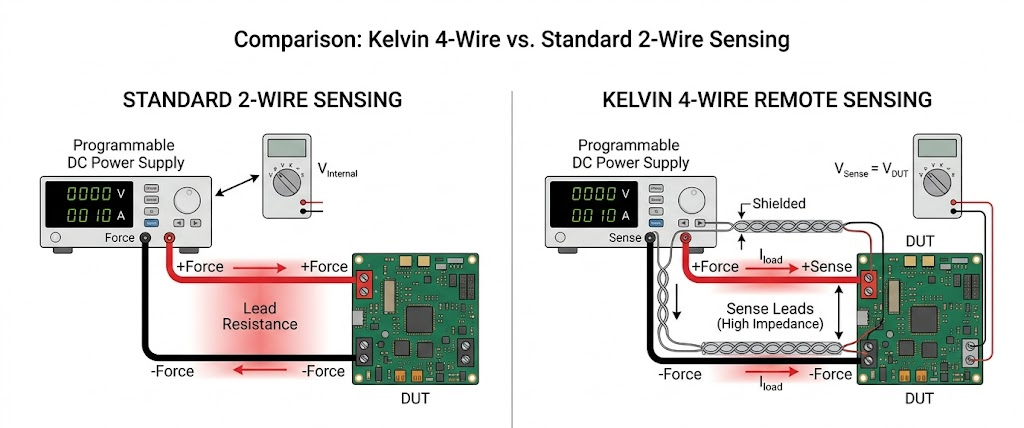
Kelvin 4-wire remote sensing resolves distribution losses by establishing independent electrical paths for current delivery and voltage measurement. While standard 2-wire setups suffer significant IR voltage drops across lead resistance ($V_{drop} = 2 \times I_{load} \times R_{lead}$), dedicated high-impedance sense lines conduct virtually zero current, sensing the precise potential directly at the device under test (DUT) terminals. To maintain closed-loop feedback stability and prevent LC phase lag oscillation induced by long lead inductance and DUT decoupling capacitance, engineers must use shielded twisted-pair sense lines and configure proper high-frequency RC damping networks across programmable DC power supplies output terminals.
Key Takeaway: Kelvin 4-wire remote sensing cancels lead resistance voltage drops at the DUT terminals, while transient recovery times under 50 μs prevent false UVLO resets during dynamic load steps..
4. Electronic Loads, Battery Emulation, and Sinking Quadrants
Benchtop programmable DC power supplies and programmable electronic loads employ dynamic power semiconductor banks to sink controlled energy across four primary operational modes: Constant Current (CC), Constant Voltage (CV), Constant Resistance (CR), and Constant Power (CP). Constant Current mode maintains a rigid current sink to benchmark voltage source regulation and internal impedance under static and pulsed loads. Constant Voltage mode alters current draw to clamp terminal voltage, facilitating battery charger validation. Constant Resistance mode scales current linearly with voltage to simulate passive resistive networks, while Constant Power mode dynamically adjusts current inversely with voltage ($I = P / V$) to stress DC-DC converters exhibiting negative input resistance.
Source Measure Units (SMUs) and bidirectional programmable DC power supplies operate across multiple voltage-current quadrants, offering continuous transitions between Quadrant I (sourcing power) and Quadrant II/IV (sinking power). Unlike unipolar supplies paired with external passive loads, advanced 2-quadrant SMUs utilize active zero-burden current ammeters and seamless ranging to capture microampere sleep currents and multi-ampere transmit bursts without range-change dropout glitches. Furthermore, integrated programmable output resistance allows these systems to dynamically emulate the complex internal impedance ($R_i$) of electrochemical cells across dynamic charge and discharge cycles.
Key Takeaway: Dedicated electronic loads operating in CC, CV, CR, and CP modes enable precise dynamic stress testing, while 2-quadrant SMUs and bidirectional programmable DC power supplies allow seamless battery profiling.
5. Strategic Sourcing, Total Cost of Ownership (TCO), and Verdict
Procurement strategy in 2026 requires balancing upfront capital acquisition against lifetime operational efficiency, thermal infrastructure, and measurement uptime. Budget bench programmable DC power supplies and loads ranging from $380 to $650 provide accessible entry points for education and general firmware testing, whereas modular automated test equipment (ATE) mainframes exceeding $15,000 to $25,000 deliver essential multi-channel synchronization and sub-microampere accuracy. Organizations frequently leverage Certified Pre-Owned (CPO) units from factory-authorized liquidators to capture 30% to 50% capital savings with genuine calibration coverage, while deploying short-term equipment rentals for high-power compliance and qualification surges.
The definitive selection depends on primary testing priorities: the Keysight E36313A stands as the premier benchtop choice for ultra-low noise analog, mixed-signal, and precision RF R&D; the Keysight N6705C paired with the N6781A SMU represents the industry benchmark for IoT battery drain characterization and power profiling; the ITECH IT6000C and Chroma 62000D/63200A dominate high-power electric vehicle, solar inverter, and energy storage testing via regenerative grid feedback; and the Siglent SPD3303X-E and SDL1020X-E provide unbeatable cost-to-performance value among bench programmable DC power supplies.
Key Takeaway: The Keysight E36313A remains the gold standard for low-noise R&D benches, while the Keysight N6705C SMU leads IoT battery drain analysis and ITECH dominates high-power regenerative testing.
6. Technical Manuals and Official References
- Keysight E36300 Series Datasheet: https://www.keysight.com/
- Keysight N6705C DC Power Analyzer: https://www.keysight.com/
- Chroma 62000D Programmable Bidirectional DC Source: https://www.chromaate.com/
- ITECH IT6000C Bidirectional DC Power Supply: https://www.itechate.com/
- Siglent SPD3303X Series Power Supply: https://www.siglent.com/
7. Legal Disclaimer
All technical specifications, noise figures, transient recovery metrics, and MSRP pricing reflect manufacturer documentation valid as of 2026 and are subject to engineering revision without prior notice. Always consult primary OEM calibration guidelines and datasheets for exact operational tolerances prior to deployment in mission-critical automated test environments.