Implementing an in-house electromagnetic interference (EMI pre-compliance testing) bench requires matching receiver bandwidth architectures and front-end linearity directly to the transient characteristics of target device emission profiles. While real-time spectrum analyzers utilizing polyphase filter banks and continuous Fast Fourier Transform processing are mandatory for capturing sporadic transients in wireless and switch-mode power systems, traditional heterodyne swept receivers remain effective for stationary conducted testing when paired with appropriate line impedance stabilization networks. Successful pre-compliance evaluation relies on adhering to CISPR 16-1-1 6 dB filter dynamics, deploying transient limiters to protect front-end mixer diodes, and selecting hardware based on genuine third-order intercept dynamic range rather than raw displayed average noise level.
1. Swept-Tuned vs. Real-Time Architectures in EMI Pre-Compliance Testing
Traditional superheterodyne swept-tuned spectrum analyzers process RF inputs through an attenuator and preselector, downconverting energy with a sweeping local oscillator across a mixer into resolution bandwidth (RBW) and video bandwidth (VBW) filters. Filter settling dynamics govern this architecture, where distortion-free sweep time scales as Sweep Time = k × Span / RBW², with shape factor k between 2 and 3. Under standards requiring narrow bandwidths—such as 200 Hz for CISPR Band A or 9 kHz for CISPR Band B—swept scans require hours to prevent amplitude compression. Because instantaneous bandwidth is constrained strictly to the momentary RBW, transient or frequency-hopping emissions occurring away from the local oscillator are missed entirely, reducing probability of intercept to zero.
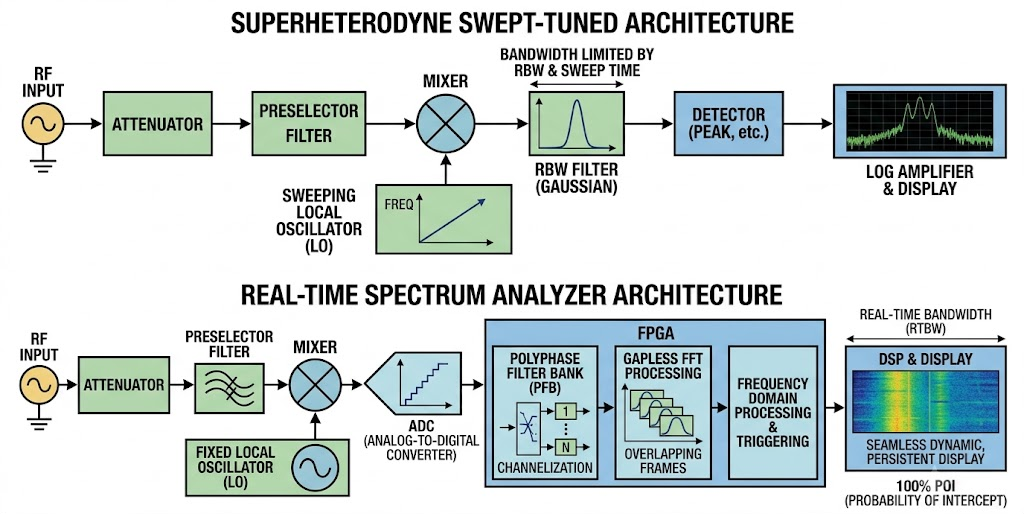
Real-Time Spectrum Analyzers (RTSA) eliminate temporal blindness by digitizing wide intermediate frequency bandwidths using ADCs sampling between 100 MSa/s and 250 MSa/s with 14-bit to 16-bit resolution. Time records stream into FPGAs executing continuous, gapless overlapping Fast Fourier Transforms via Polyphase Filter Banks. Windowing with frame overlaps of 75% to 85% eliminates scallop loss, establishing a certified 100% Probability of Intercept (POI) duration for 0 dB measurement error. Modern benchtop units achieve 100% POI ratings below 10 μs, including 7.45 μs on the Rigol RSA5000 and 7.20 μs on the Siglent SSA3000X-R across 40 MHz bandwidths, capturing transient switching events and frequency-hopping bursts that evade conventional swept analyzers.
Key Takeaway: Real-time FPGA processing with sub-10 μs 100% POI is indispensable for capturing transient switching events and frequency-agile wireless bursts that evade conventional swept-tuned analyzers.
2. Technical Benchmark Matrix (2026 Standards)
The modern pre-compliance instrumentation landscape comprises diverse receiver topologies spanning economical swept analyzers, versatile real-time engines, and enterprise microwave platforms. Selecting appropriate test hardware requires balancing core metrological figures—including Displayed Average Noise Level (DANL), Third-Order Intercept (TOI), 1 dB compression point (P1dB), and Phase Noise—against capital acquisition budgets and secondary equipment availability. The comprehensive benchmark table below compiles verified specifications, architectural categories, CISPR 16-1-1 compliance capabilities, and 2026 pricing across prominent spectrum analyzers from Rigol, Siglent, Rohde & Schwarz, and Keysight Technologies.
| Instrument Model | Architecture Category | Frequency Range | DANL (Preamp ON) | Real-Time Bandwidth (RTBW) | SSB Phase Noise (1 GHz, 10 kHz Offset) | Linearity: TOI / P1dB |
| Rigol RSA5032 / RSA5065 | Real-Time (RTSA) + Swept | 9 kHz to 3.2 GHz / 6.5 GHz | -165 dBm/Hz (typ) | 25 MHz std; 40 MHz opt | -108 dBc/Hz (typ) | TOI: +11 dBm; P1dB: 0 dBm |
| Rigol RSA3015E / RSA3030E | Real-Time (RTSA) + Swept | 9 kHz to 1.5 GHz / 3.0 GHz | -161 dBm/Hz (typ) | 10 MHz std | -102 dBc/Hz (typ) | TOI: +10 dBm; P1dB: 0 dBm |
| Siglent SSA3000X-R Series | Real-Time (RTSA) + Swept | 9 kHz to 3.2 / 5.0 / 7.5 GHz | -165 dBm/Hz (typ) | 25 MHz std; 40 MHz opt | -98 dBc/Hz | TOI: +10 dBm; P1dB: 0 dBm |
| Siglent SSA5000A Series | Real-Time (RTSA) + Swept | 9 kHz to 13.6 / 26.5 GHz | -165 dBm/Hz (typ) | 25 MHz std; 40 MHz opt | -105 dBc/Hz (typ at 1 GHz) | TOI: +15 dBm nom; P1dB: > +5 dBm |
| Siglent SSA3000X Plus | Swept Superheterodyne | 9 kHz to 2.1 GHz / 3.2 GHz | -161 dBm/Hz | N/A (Standard Swept IF) | -98 dBc/Hz | TOI: +10 dBm; P1dB: -5 dBm |
| Rohde & Schwarz FPC1500 | Swept + Gen + VNA | 5 kHz to 1 GHz (opt to 2 / 3 GHz) | -165 dBm/Hz (typ, preamp ON) | N/A (Standard Swept IF) | -92 dBc/Hz (typ @ 30 kHz off, 500 MHz) | TOI: > +7 dBm (+10 dBm at 2.4 GHz) |
| Rohde & Schwarz FPL1000 Series | Swept / FFT Benchtop | 5 kHz to 3 GHz / 7.5 GHz | -166 dBm/Hz (typ, 10 MHz–2 GHz) | 12.8 MHz std; 40 MHz opt | -108 dBc/Hz (typ at 1 GHz) | TOI: +20 dBm (typ); P1dB: +7 dBm nom |
| Keysight CXA N9000B | Enterprise Swept / Digital IF | 9 kHz to 3.0 / 7.5 / 13.6 / 26.5 GHz | -163 dBm/Hz (at 1 GHz) | 10 MHz std; 25 MHz opt | -110 dBc/Hz (at 1 GHz) | TOI: +15 dBm nom; P1dB: +3 dBm |
Hardware procurement data underscores distinct functional tiers where capital investment aligns with device emission profiles. Midrange real-time analyzers like the Rigol RSA5000 and Siglent SSA3000X-R deliver versatile troubleshooting by pairing transient capture up to 40 MHz RTBW with optional tracking generators and reflection analysis. Specialized swept platforms such as the Rohde & Schwarz FPC1500 optimize capital expenditure for conducted screening through internal VSWR bridges, while microwave platforms like the Siglent SSA5000A and Keysight CXA N9000B extend pre-compliance characterization up to 26.5 GHz for radar and satellite applications.
Key Takeaway: Hardware selection must balance real-time bandwidth capabilities against front-end linearity, ensuring the analyzer resolves wideband dynamic events without inducing internal harmonic or intermodulation distortion.
3. CISPR 16-1-1 Metrology & Detector Physics
Commercial spectrum analyzers utilize 3 dB Gaussian filters to resolve continuous carriers, but regulatory compliance under CISPR 16-1-1 mandates 6 dB impulse bandwidth definitions across designated bands: Band A (9 kHz to 150 kHz at 200 Hz), Band B (150 kHz to 30 MHz at 9 kHz), Bands C and D (30 MHz to 1000 MHz at 120 kHz), and Band E (1 GHz to 18 GHz at 1 MHz). The 6 dB bandwidth models an analog LC resonator under impulse excitation, guaranteeing uniform broadband pulse spectral density measurements. CISPR 16-1-1 establishes Peak, Quasi-Peak, Average, and RMS-Average detectors, where Peak defines the mathematical ceiling: V_Peak ≥ V_Quasi-Peak ≥ V_Average.
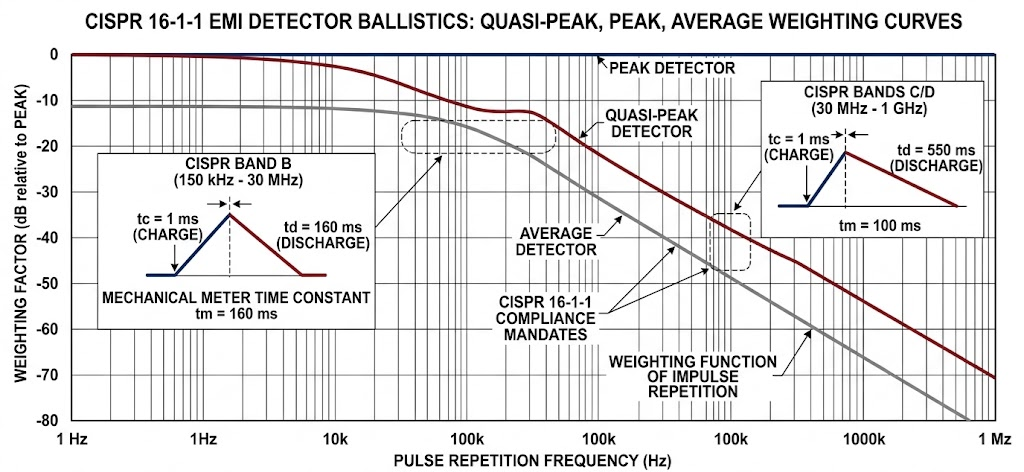
The Quasi-Peak detector evaluates impulse disturbances based on auditory perception, charging a capacitor through asymmetric charge (tc) and discharge (td) time constants buffered into a meter circuit with mechanical time constant ™. In Band B, tc is 1 ms, td is 160 ms, and tm is 160 ms, while Bands C and D set tc to 1 ms, td to 550 ms, and tm to 100 ms, accumulating voltage based on repetition frequency. Because settling requires dwelling 3 to 5 times tm, sweeping Band B natively requires 1.84 hours, while Bands C and D exceed 4.4 hours. Practical pre-compliance bypasses this delay via a two-stage methodology: an initial rapid Peak scan flags suspect emissions within 6 dB of regulatory limits, followed by targeted Quasi-Peak re-measurement.
Key Takeaway: CISPR 16-1-1 compliance demands 6 dB impulse bandwidth filtering and charge-discharge detector ballistics, necessitating a two-stage pre-scan workflow or real-time FFT acquisition to circumvent multi-hour dwell times.
4. Conducted vs. Radiated Topologies: LISN, Probes, and Front-End Protection
Conducted emissions testing captures interference propagating along supply lines between 9 kHz and 30 MHz for commercial equipment, extending to 108 MHz under automotive standards like CISPR 25. The setup requires a Line Impedance Stabilization Network (LISN), or Artificial Mains Network, which provides a calibrated 50 Ω RF reference load across power lines, attenuates grid noise, and capacitively couples disturbance voltages into the 50 Ω receiver terminal. Commercial AC mains testing utilizes a 50 μH + 5 Ω || 50 Ω network, such as the Tekbox TBLC08, while DC automotive testing specifies a 5 μH || 50 Ω network like the Tekbox TBOH01. This constrained setup provides high repeatability without requiring an anechoic chamber.
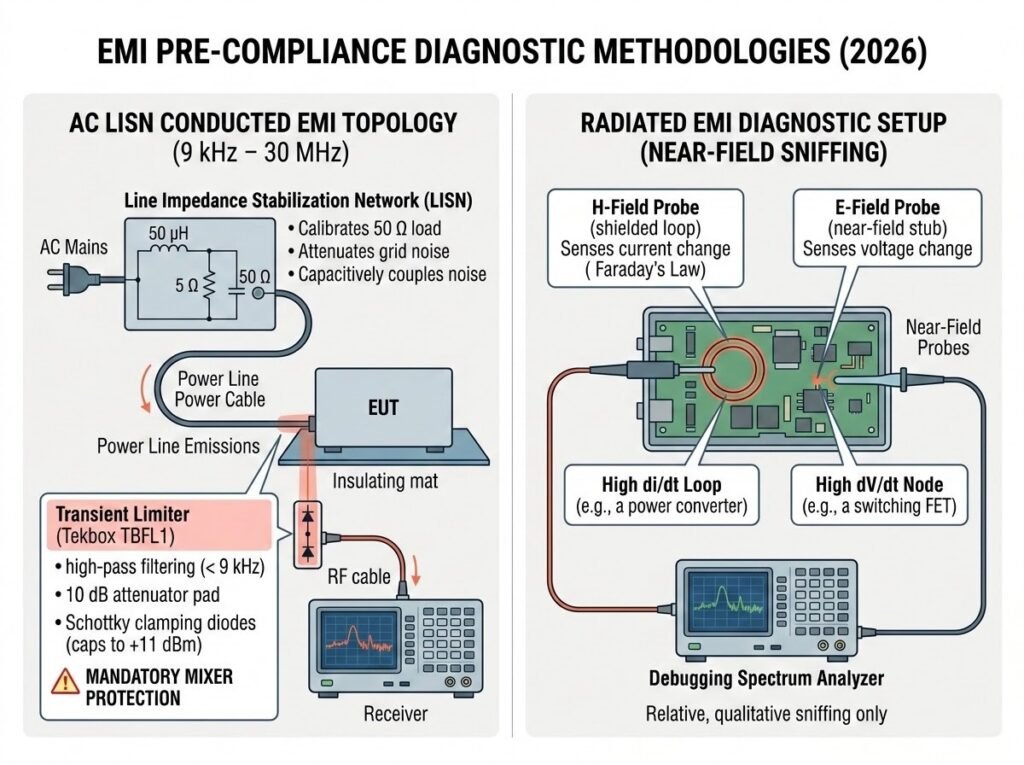
Radiated troubleshooting relies on near-field magnetic (H-field) and electric (E-field) probes to identify localized PCB noise sources, seams, and cables. H-field shielded loops exploit Faraday’s Law (V = -dΦ/dt = -μ₀ × A × dH/dt) to detect high di/dt loops, characterized by transfer impedance ZT (dBΩ) = V_rx (dBμV) – I_loop (dBμA), while E-field stubs sense high dV/dt switching nodes (I = C × dV/dt). Converting near-field readings to far-field field strengths (dBμV/m at 3 m) is metrologically invalid: reactive near-field wave impedance depends on source geometry and decays as 1/r³, unlike far-field waves which converge to 377 Ω and decay as 1/r. Furthermore, near-field sniffing cannot capture cable common-mode radiation where 5 μA at 100 MHz breaches CISPR 32 Class B limits; hence, near-field probing remains strictly relative, while TEM/GTEM cells enable calibrated chamberless qualification.
Key Takeaway: Near-field probes serve strictly as relative qualitative debugging tools for identifying emission sources, as reactive field physics and common-mode cable currents prevent direct mathematical conversion to far-field compliance levels.
5. Dynamic Range, Linearity, and Tracking Generator S11 Analysis
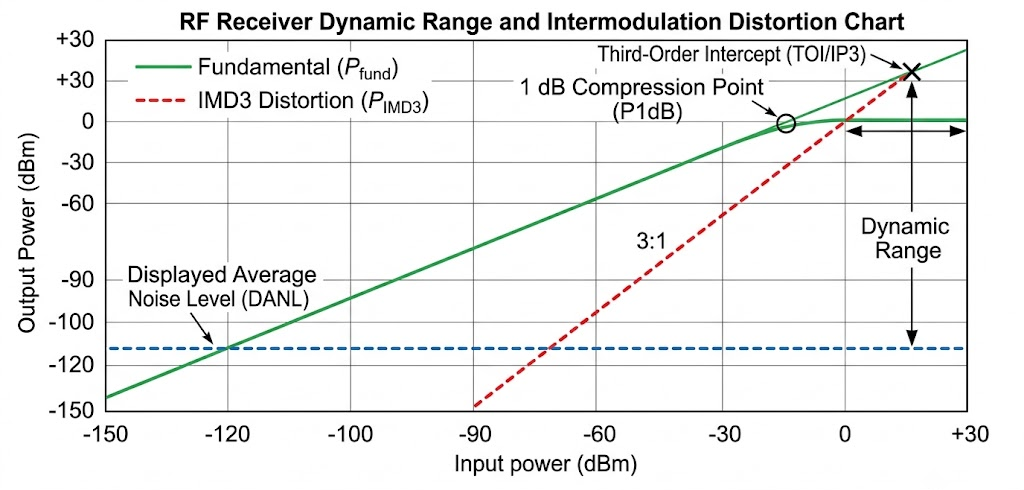
Receiver dynamic range defines sensitivity and distortion immunity. Displayed Average Noise Level (DANL) scales with bandwidth: Noise Floor (dBm) = DANL (dBm/Hz) + 10 × log10(RBW), where engaging an internal preamplifier lowers noise figures down to -165 dBm/Hz via Friis’ formula. High sensitivity is vital in 3-meter radiated testing where CISPR 32 Class B permits 30 dBμV/m at 30 MHz, yielding terminal signals below -110 dBm after antenna factors and cable loss. However, preamplification degrades linearity by reducing the 1 dB compression point (P1dB) by 15 dB to 20 dB and degrading Third-Order Intercept (TOI = P_fundamental + (P_fundamental – P_IMD3) / 2). Enterprise platforms maintaining mixer P1dB above +5 dBm and TOI above +15 dBm prevent strong out-of-band signals from generating internal intermodulation products that mimic non-compliant emissions.
Operating spectrum analyzers with conducted LISNs introduces severe risks from AC turn-on transients, where coupling capacitors discharge mains voltages up to ±325 V into mixer diodes rated for +20 dBm to +30 dBm RF and 25 V to 50 V DC. Inserting a dedicated transient limiter like the Tekbox TBFL1 is mandatory, providing high-pass filtering below 9 kHz, a 10 dB attenuator pad, and Schottky clamping diodes capping output power at +11 dBm under 5 W overloads. For scalar network analysis and S11 return loss testing using a tracking generator and VSWR bridge, thermal drift requires a 45-minute warm-up to avoid baseline tilts. External bridge directivities between 20 dB and 25 dB introduce errors exceeding ±3 dB for return loss beyond 20 dB, favoring internal calibrated bridges, while oven-controlled crystal oscillators (OCXO) eliminate drift in narrow resolution filters.
Key Takeaway: Robust front-end transient protection is mandatory during LISN testing to prevent catastrophic mixer failure, while high mixer linearity and thermal stabilization are essential for preserving measurement integrity under high-amplitude out-of-band excitation.
6. Strategic Sourcing & Selection Verdict
Procurement strategy must align capital expenditure with device emission dynamics. For teams building mixed-signal IoT hardware incorporating pulse-skipping power converters, Bluetooth Low Energy, and Wi-Fi 6E/7 transceivers, a Real-Time Spectrum Analyzer featuring sub-7.5 μs 100% POI is mandatory. The Rigol RSA5000 series provides exceptional value with -108 dBc/Hz phase noise, CISPR detectors, and 40 MHz real-time bandwidth, while the Siglent SSA3000X-R offers real-time transient detection alongside vector network analysis up to 7.5 GHz. In microwave regimes up to 26.5 GHz, the Siglent SSA5000A delivers 40 MHz RTBW and high linearity at an accessible cost, whereas the Keysight CXA N9000B remains the enterprise benchmark for automated SCPI compliance, formal test-house correlation, and low phase noise.
For laboratories focusing on conducted mains pre-compliance between 150 kHz and 30 MHz alongside near-field debugging below 3 GHz, the Rohde & Schwarz FPC1500 delivers remarkable capital efficiency. By integrating a sensitive swept receiver, software-enabled frequency expansion up to 3 GHz, an independent signal generator, and an internal calibrated VSWR bridge, the FPC1500 executes conducted testing and S11 evaluations with superior baseline stability. When applications require resolving faint harmonic emissions adjacent to high-power intentional carriers, mixer linearity and phase noise take precedence over raw DANL; here, the Rohde & Schwarz FPL1000 excels with +7 dBm P1dB, +20 dBm TOI, and pristine spectral purity, preventing internal intermodulation from distorting compliance margins.
Key Takeaway: Match instrument architecture directly to emission dynamics: select real-time FPGA engines for transient mixed-signal debugging, high-linearity receivers for crowded RF spectra, and integrated scalar platforms for economical conducted emissions screening.
7. Technical Documentation & Primary References
- Keysight Technologies: CXA Signal Analyzer N9000B Datasheet, Doc 5992-1274EN; Making EMI Compliance Measurements, App Note 5991-1756EN. https://www.keysight.com/us/en/product/N9000B/cxa-signal-analyzer-multi-touch-9-khz-26-5-ghz.html
- Rohde & Schwarz: R&S FPL1000 Product Brochure, PD 5214.6974.12; R&S FPC1500 Datasheet, PD 3607.2313.42; EMI Debugging with R&S FPC1000 and FPC1500, App Note PD 5216.0121.32. https://www.rohde-schwarz.com/us/products/test-and-measurement/benchtop-analyzers/fpl-spectrum-analyzer_63493-465280.html
- Siglent Technologies: SSA3000X-R Real-Time Spectrum Analyzer Datasheet, Doc DS0703R-E02A; SSA5000A Spectrum Analyzer Datasheet, Doc EN02A. https://www.siglent.eu/spectrum-analyzers/ssa3000x-r-series
- Rigol Technologies: RSA5000 Real-Time Spectrum Analyzer Datasheet, Doc DSA22101-1110; RSA3000E Spectrum Analyzer Specifications, Doc DSA24101-1110. https://www.rigolna.com/products/spectrum-analyzers/rsa3000/
- International Electrotechnical Commission: CISPR 16-1-1: Radio disturbance and immunity measuring apparatus, Ed 5.0. https://cdn.standards.iteh.ai/sist-preview/13548/25536324734a441c9e9b96f8c9043e22/CISPR-16-1-1-2003.pdf
- Tekbox Digital Solutions: How to Correctly Use Spectrum Analyzers for EMC Pre-Compliance Tests, App Note AN-042; Manuals for TBLC08 AC LISN, TBOH01 DC LISN, TBFL1 Transient Limiter. https://www.tekbox.com/downloads/
8. Legal Disclaimer
This engineering guide is published strictly for technical evaluation and pre-compliance diagnostic purposes. Pre-compliance measurements conducted with benchtop spectrum analyzers, near-field probes, and line impedance stabilization networks provide relative risk reduction but do not replace formal certification testing conducted by an accredited test laboratory operating in accordance with ISO/IEC 17025. The author and publisher disclaim all legal liability for regulatory non-compliance, test equipment damage, or personal injury resulting from improper mains connections or high-voltage transient events.