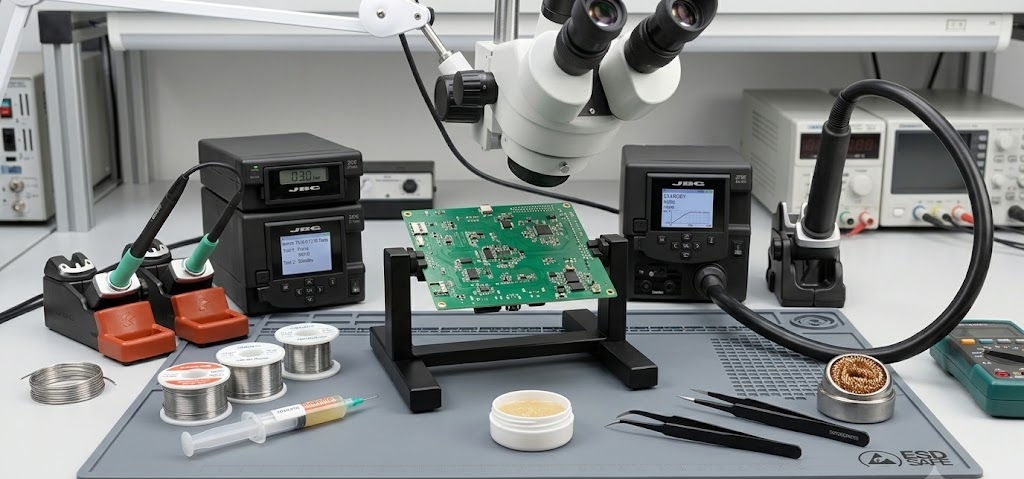
When selecting industrial soldering stations for high-reliability electronics manufacturing, active cartridge Active cartridge ecosystems like the JBC CD-2BQF and Weller WXsmart deliver unmatched thermal recovery and sub-50-millisecond closed-loop feedback by swaging the heating element and thermocouple directly into the galvanic tip mass, establishing the benchmark for multilayer lead-free manufacturing. In contrast, low-mass decoupled ceramic platforms like the Ersa i-CON 1 MK2 provide near-active thermal dynamics at a fraction of the consumable cost, whereas legacy passive irons like the Hakko FX-888D suffer from severe interfacial air-gap resistance and sensor propagation lag. For non-contact SMD and BGA rework, high-flow closed-loop convective systems like the JBC JTSE and Hakko FR-810B provide the thermal energy required for dense ground planes, while hybrid infrared-convection platforms like the Ersa HR 100 eliminate component displacement on delicate 01005 passives.
| Application Class | Primary Recommendation | Heating Architecture | Key Advantage | Typical 3-Year TCO |
| Class-3 Mission-Critical | JBC CD-2BQF (T245) | Active Swaged Cartridge | Instantaneous recovery (<2.3s), zero freezing | $2,201 |
| Industry 4.0 Traceability | Weller WXsmart | Smart Active Cartridge | Full audit tracking, optoisolated handle | $4,964 |
| High-Volume Commercial | Ersa i-CON 1 MK2 | Low-Mass Decoupled Ceramic | Near-active dynamics at $13.50 tip cost | $790 |
| Entry-Level Rework/Hobby | Hakko FX-888D | Passive Ceramic Rod | Lowest initial entry CAPEX ($115–$130) | $557 |
| High-Power Convective | Hakko FR-810B | Turbine Convection (1200 W) | High flow (115 L/min), vacuum pickup | Bench Asset |
| Micro-SMD / 01005 Rework | Ersa HR 100 | Hybrid IR / Micro-Convective | Zero component blow-off, gentle aperture | Specialized |
1. Thermal Transfer Physics, Interface Impedance, and Sensor Lag
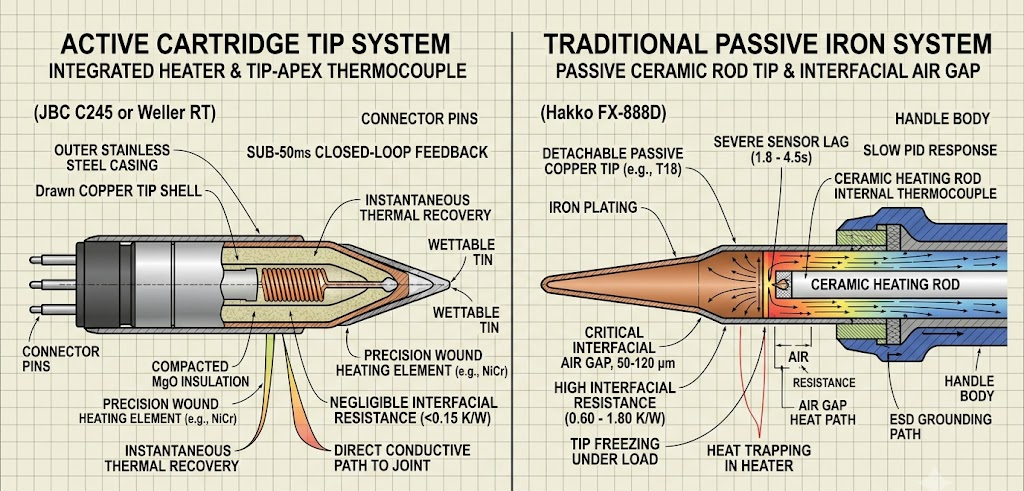
Conductive thermal energy delivery from a soldering iron to a printed circuit board joint is governed by Fourier’s Law of thermal conduction:
q = -k × A × (dT/dx)
where q is conductive heat flux, k is material thermal conductivity (roughly 390 W/m·K for oxygen-free copper, 70 W/m·K for protective iron plating, and 0.026 W/m·K for stagnant air), A is effective contact surface area, and dT/dx is the thermal gradient. The primary rate-limiting factor in hand soldering is total series thermal impedance:
R_total = R_heater + R_interface + R_copper + R_iron + R_solder
In passive tip-over-ceramic irons like the Hakko FX-888D, a 50 to 120 μm mechanical clearance gap between the ceramic heating rod and the copper tip bore introduces an interfacial boundary resistance (R_interface) of 0.60 to 1.80 K/W. This air gap, aggravated by internal copper oxidation flaking over repeated heating cycles, severely chokes heat transfer and requires the heating element to idle up to 100 °C above the target process temperature to push energy across the void. In contrast, active cartridges swage the heating resistance wire within compacted magnesium oxide insulation (MgO, k ≈ 30 W/m·K) directly inside the drawn copper tip shell, reducing R_interface to a negligible 0.05 to 0.15 K/W for immediate, uninhibited thermal conduction.
Closed-loop thermal regulation is fundamentally constrained by sensor propagation delay, dictated by the thermal diffusion timescale equation:
t_diff ≈ x² / (2 × α)
where x is the physical distance between the joint load and the sensor junction, and α is thermal diffusivity:
α = k / (ρ × C_p)
In passive irons, the thermocouple is housed inside the ceramic core, separated from the tip working face by 12 to 20 mm of ceramic, air, and copper. This physical offset creates a severe sensor delay of 1.8 to 4.5 seconds, preventing the proportional-integral-derivative (PID) control loop from responding until joint temperature drops significantly. Active cartridges position the thermocouple junction directly at the apex or laser-weld it millimeters behind the working face, cutting detection latency to under 50 milliseconds.
Under lead-free SAC305 alloy (melting point 217 °C) loads on multilayer boards with 2oz copper ground planes, joint temperatures must reach 235 to 245 °C within 2 to 4 seconds. While a passive iron plunges below 205 °C and freezes for 5 to 9 seconds, an active cartridge station like the JBC CD-2BQF experiences only a 22 to 30 °C dip, delivering 130 W of peak transient power to stabilize the joint within 1.2 to 2.2 seconds.
Key Takeaway: Swaged active cartridges compress interfacial thermal impedance to 0.05–0.15 K/W and slash sensor lag to under 50 milliseconds, eliminating the thermal choke and solder freezing typical of passive irons on heavy ground planes.
2. Electrical Overstress (EOS) and ESD Safety Metrology
In mission-critical electronics manufacturing, IPC J-STD-001 and ANSI/ESD S20.20 mandate strict electrical limits for hand soldering tools: tip-to-ground resistance must measure strictly below 2.0 Ω, and tip-to-ground leakage potential must remain strictly below 2.0mV RMS under live operating conditions. These stringent thresholds protect ultra-thin dielectric layers in sub-micron MOSFETs, RF gallium nitride (GaN) high-electron-mobility transistors, and silicon-on-insulator (SOI) switches.
Modern commercial semiconductors feature gate oxide layers measuring between 1.2 and 3.0 nm in thickness. Given that the intrinsic dielectric breakdown electric field of silicon dioxide (SiO2) is roughly 10 MV/cm (or 1.0 V/nm), a 2.0 nm oxide layer suffers catastrophic, irreversible dielectric breakdown under transient voltages exceeding 2.0 to 3.5 V. Furthermore, sub-breakdown transients between 1.0 and 1.8 V can trigger Fowler-Nordheim electron injection, generating micro-structural trap defects within the dielectric that degrade threshold voltages and induce latent component failures in the field.
Tip-to-ground electrical leakage in uncertified benchtop equipment is driven primarily by inter-winding capacitive coupling within the station step-down transformer and high-frequency switching commutation noise. Low-cost stations omitting a grounded copper Faraday shield between primary (120/230 V AC) and secondary (24 V AC) windings exhibit parasitic inter-winding capacitances of 300 to 1200 pF. This allows high-frequency mains spikes to bypass galvanic isolation, causing ungrounded tips to float at potentials up to 35 V peak. Simultaneously, unshielded triac switching circuits without zero-crossing synchronization produce sharp voltage steps (high dV/dt) that induce current spikes in heater wiring, capacitively coupling directly to the tip shell.
Certified commercial systems eliminate these risks through dedicated shielding and active isolation:
- The JBC CD-2BQF incorporates an equipotential bonding terminal tied to an internal 1.25 A fast-acting earthing fuse, ensuring tip-to-ground resistance remains below 0.45 Ω and leakage potential stays under 0.8mV RMS.
- Weller WXsmart tools use optoisolated serial lines between the handle and base, isolating tips from digital control noise (<0.7mV RMS).
- The Hakko FN-1010 grounds the cartridge barrel via beryllium-copper contact springs (<0.7 Ω).
Key Takeaway: Compliance with IPC J-STD-001 limits (<2.0 Ω resistance, <2.0mV RMS leakage) via equipotential earthing, Faraday shielding, and optoisolation prevents catastrophic dielectric puncture and latent defects in sub-micron semiconductors.
3. Industrial Soldering Stations Technical Benchmark Matrix (2026)
The following matrix contrasts technical performance parameters, electrical compliance metrics, capital expenditure, and consumable operating costs across leading industrial platforms based on verified 2026 manufacturing data:
| Model | Heating Architecture | Rated Power | Thermal Recovery Time (SAC305) | Tip-to-Ground Resistance / Potential | 2026 Station MSRP (USD) | Tip Consumable Cost |
| JBC CD-2BQF (T245) | Active Cartridge (Swaged Element) | 130 W Peak (23.5 V AC) | 1.8 to 2.3 s | <0.45 Ω / <0.8mV RMS | $692 – $760 | $36 – $46 (C245 Series) |
| JBC CD-2BQF (T210) | Active Micro-Cartridge (Micro-Mass) | 40 W Peak (23.5 V AC) | 1.0 to 1.5 s | <0.50 Ω / <0.9mV RMS | $692 – $760 | $38 – $48 (C210 Series) |
| Weller WXsmart (WXUPS) | Smart Active Cartridge (Digital Memory) | 150 W Tool / 300 W Station | 2.0 to 2.5 s | <0.60 Ω / <0.7mV RMS | $3,020 (Kit) | $48 – $62 (RTUS MS) |
| Weller WXsmart (WXMPS) | Smart Active Micro-Cartridge | 40 W Tool (12 V System) | 1.2 to 1.8 s | <0.55 Ω / <0.6mV RMS | $3,025 (Kit) | $45 – $58 (RTMS MS) |
| Hakko FN-1010 | IoT Active Composite Cartridge | 100 W Station / 95 W Tool | 2.8 to 3.5 s | <0.70 Ω / <1.1mV RMS | $1,270 – $1,420 | $35 – $42 (T36 Series) |
| Hakko FX-951 | Composite Cartridge (Integrated Sensor) | 75 W Station / 70 W Tool | 3.8 to 5.2 s | <0.85 Ω / <1.2mV RMS | $285 – $340 | $15 – $24 (T15 Series) |
| Hakko FX-888D | Passive Decoupled Ceramic Rod | 70 W Station / 65 W Tool | 7.5 to 12.0 s | <1.20 Ω / <1.5mV RMS | $115 – $130 | $6 – $12 (T18 Series) |
| Ersa i-CON 1 MK2 | Low-Mass Decoupled Ceramic / RTD | 150 W Micro-Core Element | 2.5 to 3.2 s | <0.50 Ω / <0.8mV RMS | $480 – $560 | $11 – $18 (102 Series) |
Key Takeaway: Integrated active cartridges deliver sub-2.5-second recovery and sub-millivolt leakage, while Ersa’s 150 W low-mass ceramic system matches composite recovery at an economical tip consumable price point.
4. Metallurgy, Tip Oxidation Kinetics, and Preservation Protocols
A soldering tip’s operational lifespan is governed by the dissolution kinetics of its electroplated iron barrier into molten tin, coupled with high-temperature atmospheric oxidation. Industrial tips feature an oxygen-free copper core wrapped in an electroplated iron barrier (100 to 250 μm), an intermediate nickel wetting stop (5 to 15 μm), and a micro-porous chrome exterior (10 to 20 μm).
When exposed to molten SAC305 at process temperatures between 350 and 400 °C, iron atoms dissolve continuously into the liquid tin puddle, forming a brittle FeSn2 intermetallic compound layer. The rate of this iron leaching is dictated by the Arrhenius dissolution relationship:
k_dissolution = A × exp(-E_a / (R × T))
where E_a is the activation energy for iron dissolution in liquid tin (roughly 60 to 75 kJ/mol), R is the universal gas constant (8.314 J/mol·K), and T is absolute temperature in Kelvin. Raising tip temperature from 340 °C (613 K) to 400 °C (673 K) accelerates the iron dissolution rate by roughly 3.8 times, jumping from 0.30 μm/hr to 1.15 μm/hr under continuous liquid alloy contact. Once the molten tin breaches the iron barrier, it aggressively leaches the underlying copper core through Cu6Sn5 and Cu3Sn intermetallic formations, creating internal voids that destroy tip geometry and thermal conduction.
Mitigating iron dissolution requires automated thermal setback protocols paired with non-destructive mechanical cleaning methodologies. Modern stations feature intelligent tool holsters that detect tool placement via electrical or micro-switch contacts, dropping the tip temperature to a 150 to 180 °C standby state within 15 to 30 seconds. At 150 °C, SAC305 alloy solidifies, halting intermetallic migration and reducing tin oxidation (Sn + O2 → SnO2) by over 90% compared to holding at 350 °C. Extended cradle downtime past 5 to 15 minutes triggers deep hibernation, disconnecting power entirely to let the cartridge cool to room temperature, which extends tip life up to five times in active production lines.
Cleaning techniques also govern plating integrity: wiping a 370 °C tip across a wet cellulose sponge induces severe thermal shock, dropping the working surface temperature by 180 to 240 °C in under 200 milliseconds. Because copper and iron possess divergent coefficients of thermal expansion (16.5 × 10^-6 /K for copper versus 11.8 × 10^-6 /K for iron), this sudden contraction generates shear stresses across the electroplated boundary, producing micro-fissures in the iron shell that accelerate tin penetration. In contrast, dry coiled brass wool (60% Cu, 40% Zn) is mechanically softer than the iron barrier, removing oxidized flux without abrading protective coatings while causing a negligible temperature drop of only 10 to 20 °C.
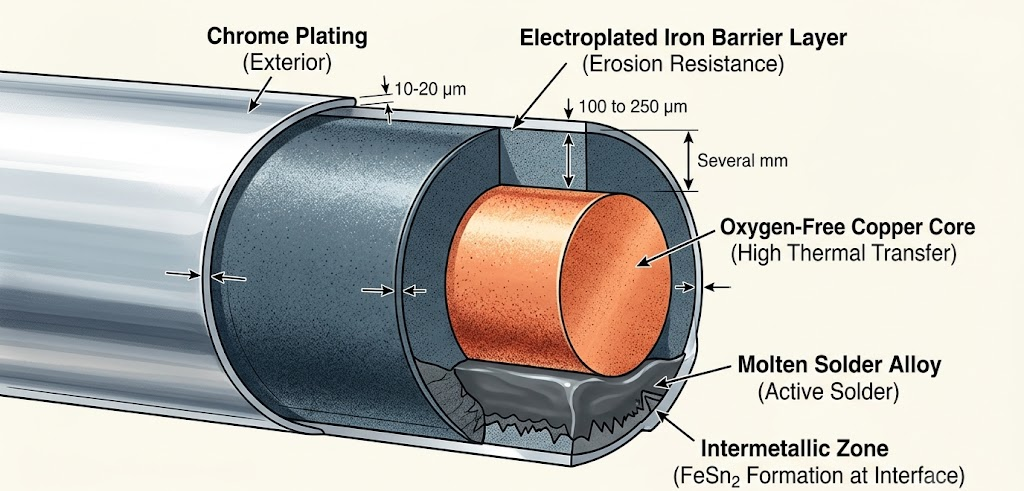
Key Takeaway: Tip erosion follows Arrhenius dissolution kinetics where elevating temperatures from 340 to 400 °C quadruples iron loss; deploying automated 150 °C sleep stands and dry brass wool extends tip life up to fivefold.
5. Convective and Hybrid Hot-Air SMD/BGA Rework Platforms
Dedicated hot-air rework systems deliver non-contact convective thermal energy to handle surface-mount devices (SMD) and ball grid array (BGA) components. Stations diverge between dynamic closed-loop thermal profiling and open-loop airflow delivery. Mid-tier benchmarks like the Quick 861DW (1000 W) utilize a maintenance-free brushless whirlpool motor delivering 1 to 120 L/min of air with zero-crossing triac regulation. Similarly, the Hakko FR-810B features an internal turbine providing up to 115 L/min of air with up to 1200 W of heating output (230 V), using an integrated vacuum pickup indicator to detect the exact moment solder reaches liquidus reflow.
However, unprofiled open nozzles generate turbulent perimeter air vortices that ingest ambient air, causing thermal variations across large packages. To ensure process repeatability, high-end platforms like the JBC JTSE (700 W, 5 to 50 SLPM) and JBC TESE (300 W, 2 to 17 SLPM) incorporate dynamic closed-loop thermal profiling driven by external Type-K thermocouples placed directly on the PCB assembly. Rather than relying on static exhaust temperatures, the system throttles convective energy based on real-time board temperatures, executing controlled ramp, soak, and reflow cycles that prevent package warpage and adjacent component disturbance.
Reworking delicate micro-miniature components, such as 0201 and 01005 passives, introduces the persistent risk of component blow-off caused by convective airflow velocity and diaphragm pump pulsation. The Ersa HR 100 hybrid rework system overcomes this dynamic displacement by combining medium-wave infrared radiation with focused micro-convective airflow. The ergonomic hand tool incorporates a 200 W hybrid heating element emitting 400 W of combined thermal energy through exchangeable optical aperture nozzles. The radiant infrared spectrum directly penetrates flux layers and component bodies without exerting mechanical gas pressure, heating high-mass BGA balls and reflective metallic leads evenly. Concurrently, the gentle micro-convective flow eliminates localized infrared thermal shadowing without creating turbulent air currents. This hybrid energy delivery eliminates component blow-off on fine-pitch 01005 passives, prevents delicate FR-4 resin laminate blistering, and provides uniform, repeatable thermal profiles across dense circuit board assemblies.
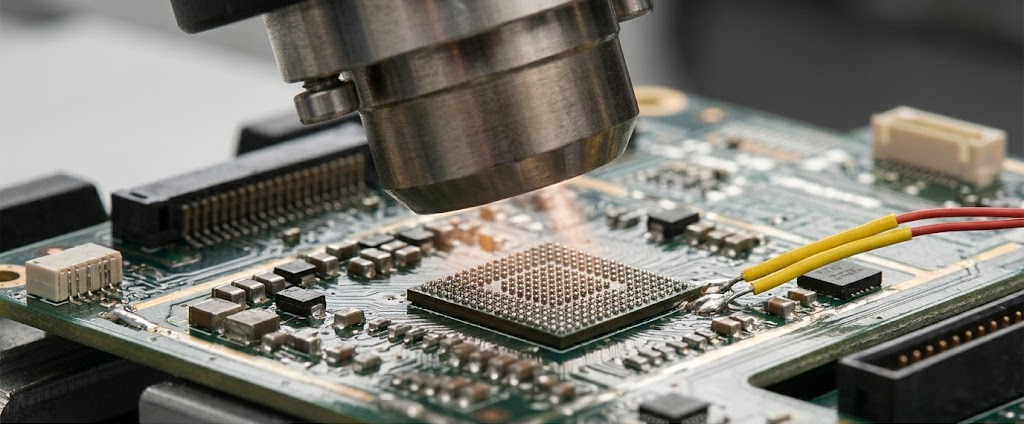
Key Takeaway: Closed-loop thermocouple feedback in stations like the JBC JTSE ensures repeatable BGA reflow, while hybrid infrared-convection platforms like the Ersa HR 100 eliminate component blow-off on ultra-miniature 01005 passives.
6. Three-Year TCO Analysis and Procurement Verdict
Evaluating production equipment requires balancing initial capital expenditure (CAPEX) against consumable tip operating expenses (OPEX) over a three-year lifecycle. In a standard single-shift industrial facility (8 hours per day, 250 production days per year, totaling 750 shifts and 6,000 operational hours) using SAC305 lead-free alloy, tip consumption represents the dominant long-term expense:
- Hakko FX-888D: A budget passive iron features a low $125 CAPEX and $9 T18 tips. Due to continuous thermal cycling without intelligent sleep setback, its tip life averages 125 operational hours, requiring 48 replacements over three years ($432 OPEX) for a total 3-year TCO of $557. Its sluggish thermal recovery often leads operators to crank setpoint temperatures, accelerating lifted pads and damaged circuit traces.
- Ersa i-CON 1 MK2: Representing the optimum economic equilibrium, the 150 W Ersa platform pairs a $520 base CAPEX with low-mass slide-on tips costing $13.50 each. Benefiting from internal RTD feedback and automated standby modes, tip lifespan reaches 310 operational hours. A 6,000-hour production run consumes approximately 20 tips ($270 OPEX), yielding a three-year TCO of $790. This matches the TCO of the lower-powered Hakko FX-951 ($310 CAPEX + 24 tips at $20 = $790 TCO) while delivering transient thermal dynamics comparable to active systems.
- JBC CD-2BQF: Demanding a $725 station CAPEX and $41 active cartridges, its automated ultra-low sleep mode ensures an average tip life of 170 operational hours under demanding lead-free loads. Consuming roughly 36 cartridges over 6,000 hours ($1,476 OPEX) results in a three-year TCO of $2,201. The investment is directly recouped via near-zero joint defect rates and rapid cycle times on multilayer assemblies.
- Weller WXsmart: With an enterprise kit entry point of $3,020 and $54 RTUS cartridges, consumption of 36 tips ($1,944 OPEX) results in a 3-year TCO of $4,964. This platform is justified where automated process logging, digital traceability, and strict calibration locks are required by quality assurance contracts.
For mission-critical Class-3 electronics manufacturing under IPC-A-610 standards (aerospace, defense, and implantable medical devices), the JBC CD-2BQF and Weller WXsmart are the premier choices. Their active cartridge architectures eliminate cold solder joints on multilayer ground planes, while Weller’s optoisolated digital handles guarantee traceability for aerospace audits. For high-volume commercial electronics assembly where operating costs dominate, the Ersa i-CON 1 MK2 is the primary recommendation, delivering active-level thermal recovery without high cartridge overhead. For convective rework benches, deploy the Quick 861DW as a general-purpose workhorse, step up to the Hakko FR-810B for high-thermal-mass assemblies requiring vacuum pickup verification, and utilize the JBC JTSE or Ersa HR 100 where closed-loop thermal profiling and component stability on miniature passives are essential.
7. Technical Documentation and Primary References
Manufacturer engineering datasheets, user manuals, and calibration directories for the platforms evaluated in this guide are directly accessible through the following canonical links:
- JBC Tools CD-B Soldering Station Specification and Architectural Data
- JBC Tools JTSE High Power Hot Air Rework System Specifications
- Weller WXsmart Industrial Soldering Platform Ecosystem
- Weller Tools Apex Tool Group Industrial Hand Soldering Catalog
- Hakko Global FN-1010 IoT Soldering Station Operational Specifications
- Hakko Global FX-951 Temperature Controlled Station Manual
- Hakko Global FR-810B High Power SMD Hot Air Rework Station Documentation
- Kurtz Ersa Industrial Hand Soldering Systems and i-Tool Technology
- Kurtz Ersa HR
- Quick Professional Soldering and Desoldering Station Catalog
8. Legal Disclaimer
Specifications, electrical overstress (EOS) thresholds, thermal recovery metrics, and 2026 list prices cited in this guide reflect manufacturer datasheets and verified industrial distributor catalog data. Technical parameters and commercial terms are subject to factory revisions and engineering updates. Operational parameters must be independently verified against specific facility IPC and ESD compliance standards.